Enmesh

I knew when I hung the black dress at Michaelmas.

My garden is alight. Light flows, a
slow transmogrification from blackish
grey to a popping green. Every little
thing is in its place, nothing is too small.
A blade of grass, dew-atop, is an amber
bead, an ornate knife blade.

The work of darknesses are done, for there
is more than one darkness in any life.
Mine has been the violence of men.
I could feel yours feathering inches from my face.
I fell into your darkness like Alice through her glass.
There's a storm-polished red apple high, high
in the neighbour's tree. Is it for me?

I thought of you, of her,
of the 'endless possibilities of love'—decided, no more!


Enmesh first published Washing Windows V, Women Revolutionise Irish Poetry 1975-2025. Editors, Nuala O' Connor and Alan Hayes.
Online URL: https://booksupstairs.ie/product/washing-windows-v/
Tag: Contemporary Irish Women Poets
-
-
The Trees, Dawn

Late, the willow pushes out her new leaf.

Great pink blossoms in bunches like
bouquets hang head-heavy against
willow's stasis.
Peonies emerge, pink and blood.

Wren piccolo,
and the heavy perfume of a dying rose.
She brings flowers that are dying. These
are mauve. Zephyr-caressed, their petals,
fawn-edged.

Shades of pungence,
of mauve pungence.
They will bow-down by morning.

I do not understand. The green leaf falls
on my black end table. Why bring the
dying to me? Haven't I had enough dying?
Your mauve roses, zephyr-curled,
are browning. Frilled.

The white cherry blossom is blown. Tulip
mouths hang open in despair. I almost step
on a white eggshell, broken, out-of-nest.
There is a dead tree and no nest above me.

The small birds have flown.
The rooks in the ancient tower
do not want to be disturbed by me.

There are trays of proliferating pansies
by the church steps. Several snails seek succor in her
door frames. A cross across a mossy path once
an egress, stops you in your tracks.

The village vases are being replenished.


© Chris Murray, 2024.
Note. "The Trees, Dawn" forms a part of my recently published work "Found Poem, Spring". The three parts of the poem are "The Trees, Night", "There Are More Blue Flowers in Spring", and "The Trees, Dawn". Thanks to the editors of Skylight47, Bernie Crawford, Ruth Quinlan and D’or Seifer for publishing this excerpt. The poem in its entire can be read here. -
The Trees, Night.

Souls in the tree of life,
their bowls ablaze–
coppering their old gold.

As day moves to evening,
all warmth leaves the trees.
Red blood in their branches
remains. Heating

her lamps.
Brighter now than ever
for a short time before
sunset, moonrise.

Souls in the tree of life,
their bowls ablaze–
Small and dwindling their flames.

Small birds fly.
Moon waxes gibbous,
its tilted egg almost there,
almost full.

Souls in the tree of life,
their copper bowls are night-warm,
small their flames.

In dead of night, their
flames flicker, dance.
The stars are trees' tongues,
moving into language.

Her lamps lit,
her diamonds hung.
It is long, long
before dawns' song.

In the bluelit
darklight,
        bluebells thread
into boundary hedges
        working up,
closed, their flowers.

Light begins round the great Yew,
setting red the comet tail of a spider's
house.

It is hanging by a thread.


© Chris Murray, October 2024.
'The Trees, Night' is an excerpt from a tripartite poem titled 'Found Poem, Spring'. The titled parts of the poem are 'The Trees, Dawn', 'There Are More Blue Flowers in Spring', and 'The Trees, Night'. The poem in its entire can be read at The Honest Ulsterman , with thanks to Editor Gregory McCartney.
-
Homing Salmon
Under the gush of shower water your greying skin
flails. In your mind you wade back to the brook,
the water icy even in summer, your seven siblings
balancing on the pebbled belly of the River Fergus,
suds in your hair, brothers dunking you under, ice forming
in your brain, penetrating your veins, Mother shouting Don’t
catch colds. No one but the river ever taught you how to swim.
Sometimes a silver fish would scurry by upriver. Everyone would freeze,
crane for a glance before it flickered past. Salmon, Father said.
Your brothers always poked the verge with sticks, boasted they could catch it.
Their brittle frames have since sailed over the shoulders of their sons
to the graveyard by the river but you remember them young.
Under the gush of shower water your greying scales
glisten in autumn sun.(First published in Crannóg 53)
The Wooden Ladder
My Grandfather was a carpenter.
Sometimes he made toys for me
with odds and ends from the firebox.
Once, he made me a ladder for my dolls;
it had three rungs, rigid and rounded.
I imagined it was cut from a fancy staircase.Its two stringers, the length of my arm—
the length of his hand, were parallel. I checked.
I learnt that word,
it means they’re standing right beside each other
but even if they go on forever in a straight line,
they will never touch.My doll’s feet didn’t need to touch the rungs
for them to leap up the ladder;
propped against a shoebox in my playroom.
They were steady in my hands
like the saw in his when he drove
his mark into the wood.(First published in the Qutub Minar Review Vol. 2)
Moss
for Ellen Hutchins (1785—1815)
“send me a moss, anything just to look at” –from Ellen’s last letter before she diedHere; a grey-cushioned Grimmia.
Here, a flaccid Brachythecium spine.
Thyme-moss, Hart’s-tongue, Sphagnum.
And let me take you under the sea;
a hive of sweet kelp, bouquet of carrageen
bedded in a throw of Dulce.
Knotted in sea spaghetti away from your fossilising name.
I hope you died looking at your moss,
stalks of haircap painting a different set of stars.(First published in Boyne Berries 27)
When I Visit You Now There’s a code for the door. No smell of rollies, no garden to capture with a disposable camera. But your brail-veined arms stretch out to me in welcome. You’re a salmon, I think, head bowed under the weight of scales and I a poet trawling natal streams upriver, digging tiers along the riverbank as we walk to the dayroom then back but you slip from my grasp, sinking to the riverbed– staring at the television. (First published in the Qutub Minar Review Vol. 2) -
Janus
His Janus head looks both ways,
Double-jointed at the neck.The honey juice of the persimmon
Bursts from their mouths,
Babbling tales in frothy tones.A river parts his muscles.
The knot in his guts is split.
Inimical flesh in the dour night,
Unborn in blackness,
You seek, four-eyed, for memories that the oil burned bright.
The Moon of Pride
The skies are thrown in a vernal frenzy.
We are strangers again
And tremble in rounded movements.We dance through the open of a new obscurity.
Our voices imagine the salt of shame,
Still insisting between lines for honesty.Pale as the moon of pride,
He plays our hands
And knits fingers into spirits.Ashes ingrain the shadow of his feet
And blunder through each sorrow of my mind.
Words Like Stars
How they flow unformed
Then fix themselves like the stars
Shivering and held up
WorshippedAnd I
And they
Staggering and squawking
Sweating and squabblingNight and day
Wobbling words
SingingDust
Dust
Dust
Corrosive mantles
Wrought to a stainStain us
Stain the water to the earth
Hold these shapes in stasisTheir lungs sooty and quivering
How they wake songs in the trenches
And beg for absolution
Apologies
I hear it now – alright?
The glass body shivering in its dress,
Its heartbeat manic-racing,
Thumping against the stones,
While your starved arms knock at my door,
While the roots play footsie in contempt …How these sounds,
Your squirming skits,
Exhaled and exiled one at a time –
Though still sweet-smelling rags –
Rock me like lullabies.
At The Temple
Skim the voices,
SwoopTheir radiance rising to an acousmatic litany –
And the other mirrors, an afterthought, skewed suffering,
Latching on toMelodic pattern nesting
It transcends
On a perch of bamboo
The viscous asphalt limits each wet corner
Dive sacrifice
The gods sheaf their poor prayers,
Partition need from want,
Smoulder the paper giftsDefine my breath,
Its crystalline vowels,
Rictus of guilt,
Unlisten to my pleas.
The Flood
A ferrous river, the earth’s appointed transgressor,
Breaches wood,
Ribbon branching through houses, fields and cars.Leaking into dark brine.
Your tight-laced breath forms an ellipsis,
The bees are noiseless above your new bed.Wade deeper, low-slung secrets,
Demand retribution,
Stand still and ventilate,
Fastness, hearth, asylum.Sore joints, sore words, sore teeth.
Crutched language.Roll over caustic carcass,
Dismantled bones,
Flesh pried by water.Break your sterile reflections.
Words Like Stars and other poems are © Roisin Ní Neachtain
 Roisin Ní Neachtain is an emerging Irish poet and artist with Asperger’s. Her work is held in international private collections and she runs a blog featuring monthly interviews with women artists. She is currently working on her first collection of poetry.
 -
Genetics
Your eyes are big and round like your father’s
but while his are the color of the Irish Sea
yours are the color of the muddy fields
on my father’s land
fit only for the peasants who worked them.
abortion day
a shadow flutters
the fish tankPublication credit: Rattle #47, Spring 2015 (ed. Timothy Green)
Lunch Break
The fridge is empty. Which means someone stole my sandwich. And stuck me with this blueberry yogurt. Expiration date two weeks ago. Who stole my lunch. Or is it at home. Retrace my steps. Retrace. Did I take my lunch off the counter. I’m not sure. I was in a hurry. I set the alarm. Remember setting the alarm. Did I lock the door. I’m sure I did. I set the alarm and locked the door. My stomach is making weird noises. I’m starving. A slightly dated yogurt should be okay. Or maybe not. I might get sick. Salmonella, E.coli. I know the symptoms. Fever, diarrhea, abdominal cramps. I’m feeling queasy. It’s this yogurt staring at me. I’ll move it. Behind the baking soda. Where no one looks. If I’m not careful, this job will kill me. It really will. Kill me. I remember setting the alarm. Did I lock the door. I’m sure I did. I’m sure.
black fly
on the cutting board
last night’s dream
Publication credit: Rattle #56, Summer 2017 (ed. Timothy Green)Irish Twins
attic rain
the backyard swing
off kilterWe share an attic room. In the corner is an old double bed that smells and sags on one side. My side. Late at night I hear my heart beat. Loud. So loud he will hear it. He will think my heart is calling him up the attic stairs. His footsteps are heavy. He smells of old spice and cherry tobacco. My eyes shut tight. I know he is there. I feel his weight. Never on my side. Always on the side she sleeps. When the bed-springs sing their sad song I fly away. Up to the ceiling. My sister is already there. Together we hold hands. Looking down we see our bodies. We are not moving. We are as still as the dead.
Publication credit: #MeToo Anthology ed. Deborah Alma (Fair Acre Press, 2018)
Dear Nancy Drew
It’s me. Your newest author.
I’m here to tell you it’s time. To come out.
Of the closet you’ve spent decades in.
It must be getting old.How long is Girl George willing to wait?
Or is Bess the one?
Whatever. Anything is possible.
That’s why they call it fiction.I’ve known for ages Ned Nickerson is window dressing.
Clever of my predecessors to use code.
Ned keeps his knickers on. Get it?Hannah the housekeeper can’t be trusted.
She’ll sell your sorry ass to the tabloids soon.
Anything can happen. It’s called fiction.Don’t go running to daddy.
Carson Drew, famous lawyer, no can do. Not in my book.
I can write anything I want about you. Even haiku:mirror moon—
her lover’s face shifts
in its frameI hope I’ve impressed you with my writing props.
Back to you. I have it on good authority. You were born this way.
A Carolyn Keene pseudonym tried to out you.
She got canned.They can’t get rid of me that fast. I’ve already got the title:
Nancy Drew, Lipstick Lesbian.It only takes one writer. One page. One voice.
Sincerely yours,
Carolyn KeenePublication credit: KYSO Flash Issue 6 Fall 2016 (ed. Clare MacQueen)
barfly
i was just a kid in those days and he was one of the bad boys the nuns warn you about and my old man told me stay far away from that one but i couldn’t help myself and when i saw him he was walking up to me with his marlboros tucked under his tee-shirt like marlon brando with those biceps and his hair smelled of his last smoke and he kissed me one of those long kisses that just ooze out of you and shake up your insides at the same time but what did i know back then not enough
which is why he’ll always be the one that got away
last call
a ceiling fan stirs
the tip jarPublication credit: Lighting the Global Lantern, ed. Terry Ann Carter (Wintergreen Studios Press, 2011)
Irish Twins and other poems are © Roberta Beary
 Roberta Beary identifies as gender-expansive and writes to connect with the disenfranchised, to let them know they are not alone. She is the author of Deflection (Accents, 2015), nothing left to say (King’s Road Press, 2009) and The Unworn Necklace (Snapshot Press, 2007, 5th ed. 2017) which was a finalist in the Poetry Society of America annual book awards. Beary is the editor of the haiku anthologies Wishbone Moon (Jacar Press, 2018), fresh paint (Red Moon Press, 2014), 7 (Jacar Press, 2013), dandelion clocks (HSA, 2008) and fish in love (HSA, 2006). Her work appears in Rattle, KYSO Flash, Cultural Weekly, 100 Word Story, and Haiku In English The First Hundred Years (Norton, 2013). Beary’s work has been nominated for Best of the Net and multiple Pushcart Prizes. She lives in County Mayo, Ireland where she edits haibun for the journal Modern Haiku.
 -
Lúb ar Lár and other poems by Máire Dinny Wren. Original Irish versions followed by English translations by Máire Dinny Wren and Kathryn Daily Ar an Chladach Dhearóil
Is cuimhin liom a bheith ag snámh,
Is cuimhin liom a bheith ar an tanalacht,
Is cuimhin liom a bheith ar an doimhneacht,
Is cuimhin liom a bheith i mbéal cuain.Ní cuimhin liom an t-uisce á thruailliú,
Ní cuimhin liom ag ithe micreachoirníní,
Ní cuimhin liom mo shláinte ag meath,
Ní cuimhin liom a bheith cloíte.Is cuimhin liom a bheith ar ghrinneall na habhna,
Is cuimhin liom a bheith ag léimtí as an uisce,
Is cuimhin liom na hiascairí ar an bhruach,
Is cuimhin liom a bheith ag snámh in éadan an easa.Ní cuimhin liom na lanntracha á scoitheadh,
Ní cuimhin liom cár chaill mé na heití,
Ní cuimhin liom ag fás cnámha saorga,
Ní cuimhin liom an claochlú.Is cuimhin liom a bheith san uisce ghléghlan,
Is cuimhin liom an fiadhúlra muirí,
Is cuimhin liom a bheith ag sealgaireacht,
Is cuimhin liom a bheith folláin.On the bleak shore
I remember swimming,
I remember being in the shallows,
I remember being in the depths,
I remember being in the mouth of the harbour.I don’t remember the polluting of the waters,
I don’t remember eating microbeads,
I don’t remember my health failing,
I don’t remember being overcome.I remember being on the riverbed,
I remember leaping from the water,
I remember the fishermen on the bank,
I remember swimming against the current.I don’t remember shedding scales,
I don’t remember where I lost my fins,
I don’t remember growing artificial bones,
I don’t remember the metamorphosis.I remember being in the bright, clear water,
I remember the wild marine creatures,
I remember foraging for food,
I remember being in the pink.I don’t remember being swept by the current,
I don’t remember being at my lowest ebb,
I don’t remember being deformed,
I don’t remember the degeneration.Now I’m disfigured and wretched,
Slowly wearing away between pieces of plastic,
My kind being wiped out by humans,
Our bones scattered on the bleak shore.This translation is © Máire Dinny Wren
Ag an Tobar Bheannaithe
Char nocht breac, bradán ná eascann
ag bun an tobair bheannaithe
nuair a thug tú cuairt air
i dtús an fhómhair.Char shiúil tú ar deiseal,
char dhúirt tú urnaí,
char iarr tú achainí
ach d’ól tú bolgam den fhíoruisceis tháinig an ghrian as na néalta
is spréigh sí a solas niamhrach
anuas ó neamh go talamh
ag cur loinnir luisneach ar an uisce.Chrom an crann coill a ghéaga
is bhronn eagnaíocht dhiaga ort
is cheol tú amhrán ó do chroí
mar chomhartha umhlaíochta.At the Holy Well
Neither trout nor salmon nor eel
Revealed at the bottom of the holy well
When you went there to visit
At the start of Autumn.You didn’t walk with the sun,
Nor did you pray.
You didn’t make a wish, but sipped
a mouthful of the clean clear waterAs the sun spilled from the clouds
Throwing bright light
From the heavens down to earth
Making the water glisten.The oak bowed its branches
Bestowing divine wisdom,
And you sang from your heart
As a sign of submission.This translation is © Máire Dinny Wren
An tÉan Dara
Mheall tú an t-éan as dair chaoráin,
mhúnlaigh tú an t-adhmad cruaidh,
á ghlanadh is á bhláthnú,
go dtáinig tú ar an smólach.Cheap tú spiorad an éin fhiáin
san adhmad chianaosta;
chuala tú a ghlór —
a cheol binn as na móinteáin.uig tusa agus an t-éan a chéile
agus sibh araon sáinnithe;
tusa gafa san aois leanbaí,
an t-éan i ndoimhneacht an fhraochlaigh.Mairfidh spiorad an éin sa dair chaoráin
mar a mhairfidh do spiorad i ngéaga do theaghlaigh.The Oak Bird
You scoured the moorland
until you found the skylark,
calming and consoling her,
you freed her from the heath.You captured the wild bird’s spirit,
and released her from the hard black wood.
You could hear her sweet voice,
melodious on the moor.You and the bird were kindred,
both trapped in your own worlds,
you snared in your second childhood,
the bird buried in the deep heath.The bird’s spirit will live in the bog oak
as your spirit will live in the branches of your kin.This translation is © Máire Dinny Wren
Cantaireacht na Murúch
Chualathas cantaireacht chiúin na murúch
mar gholtraí os cionn chrónán na dtonn,
sular nocht siad ar an tsnámh
ar imeall tíre fá bhéal na trá.Chonacthas iad ag folcadh sa tsáile
is ag cíoradh a gcuacha cuanna,
ag lupadán lapadán sa lán mara,
is ag meidhir i measc muranáin maranáin.Bhí cuid acu a scoith a gcuid lanntracha,
is a d’éalaigh as an duibheagán,
is a mhair tráth os cionn uisce,
amhail leannán agus máithreacha.Chualathas cantaireacht chaoinbhinn na murúch
á maolú ag fraoch na farraige,
a nglórtha ag meathlú le gach marbhshruth
is an taoide á dtointeáil idir muir is tír.Mermaid Chant
The faint singing of the mermaids was heard
Like a lament coming over the waves,
before they appeared on the surface,
at the edge of the shore by the strand.They were seen bathing in the sea
combing their fine hair,
splashing in the full tide
and frisking among little sea creatures.There were some who shed their scales
escaping from the depths,
living for a time on dry land
becoming lovers and mothers.The sweet faint singing of the mermaids was heard,
dampened by the fury of the waves,
their voices fading with each turn of the tide
as they flip-flopped between land and sea.This translation is © Máire Dinny Wren
An Marthanóir
Cuireadh faoi ghlas mé,
baineadh m’ainm díom,
baineadh díom mo chuid gruaige,
baineadh solas an lae díom,
baineadh díom laetha geala m’óige.Cuireadh i mbun oibre mé,
ag ní braillíní línéadaigh
ag sruthlú is ag fáscadh,
ag smúdáil is ag filleadh,
mar bhreithiúnas aithrí ar mo pheaca.Níorbh eol domh an t-am de lá,
níorbh eol domh béile folláin,
níorbh eol domh luach mo shaothair,
níorbh eol domh scolaíocht,
níorbh eol domh ceanúlacht ná teochroí.Scartha ó mo theaghlach grámhar,
scoite ó mo mhuintir,
bhí mé croíbhriste le huaigneas,
is mé fágtha mar dhílleachta,
cha raibh ionam ach páiste,
cha raibh ionam ach sclábhaí!Survivor
I was locked up,
my name taken from me,
my hair shorn,
daylight shut out,
the happy days of my youth stolen.They put me to work,
washing linen sheets,
rinsing and wringing,
ironing and folding,
as punishment for my sin.I did not know the time of day
or savour a wholesome meal,
received no wages for my effort,
nor get any schooling,
I was shown no warmth or kindness.Denied a loving family
Separated from my people,
heartbroken and homesick,
left as an orphan,
I was only a child,
I was only a slave!This translation is © Máire Dinny Wren
Lúb ar Lár
Bhí clic cleaic na ndealgán
chomh rialta le tic teaic an chloig
i gcistin mo mháthara
agus í féin ‘s mo mhóraí
ina suí cois teallaigh.
Agus an banachas tí uilig déanta,
bhí geansaithe Árann le cniotáil acu
do mhuintir Chinnéide Ard an Rátha.Mise i mo luspairt linbh
mar bheadh uan óg ann
ag meidhir i ngan fhios daofa
le cuach olann íon faoin mbord
go dtí gur thit mé as mo sheasamh
agus gur síneadh mé
ó lúb go ladhar ar an urlár –
an snáth mín cuachta thart orm.Thóg mo mháthair suas mé
mar thógfadh sí lúb ar lár;
bhain sí an snáth as an aimhréití
is rinne cion croí liom
agus shuigh ar stól beag mé;
ansin agus a humhail ar a ceird,
d’aithris sí finscéal
Cheamach na Luatha Buí dom.Phioc mise na sméara dubha
agus bhlais mé an chíor mheala
a bhí á gcniotáil aici
i bpatrún an gheansaí Árann.
Shamhail mé an Cheamach gléasta
ag imeacht i gcóiste
‘s thit mé i mo chodladh is mo chloigeann ar a glúine,
ceol na ndealgán mar shuantraí agam.Nuair a mhuscail mé,
bhí deireadh na gcutaí tochrasta
’s mo mháthair ’s mo mhóraí faoi shuan;
gan bun cleite amach ná barr cleite isteach
sna geansaithe a chniotáil siad
do lucht an rathúnais.
Cé gur bheag a gcúiteamh
ba mhór é agus an bhróg ag teannadh.Corruair, i sciortaí an mheán oíche
’s mé ag coigilt na tine,
faighimse spléachadh
ar na lámha aclaí i mbun a gceird
’s cloisim drandán na ndealgán
’s na mná ag canadh ’s ag gáirí.
Ach inniu tá na dealgáin díomhaoin
’s na geansaithe á gcniotáil ag meaisín.Dropped Stitch
The click clack of the knitting needles
Was as regular as the tick tock of the clock
In my mother’s kitchen,
As she and my grandmother
Sat by the fireside,
Their housework all done
They had Aran jumpers to knit
For the Kennedy’s of Ardara.I but a soft young child
Like a little lamb sporting on the floor
With the ball of pure wool
Unknown to them
Until I tripped and fell over
And lay flat out on the floor
The soft wool wound around me
From head to toe.My mother picked me up
Like she’d pick up a dropped stitch;
She untangled the wool
And she hugged me closely
And then sat me on a little stool;
And while she continued her work
She told me the fairytale
about Cinderella.I picked the blackberries
And I tasted the honeycomb
That she was knitting into
The pattern of the Aran jumper
I imagined Cinderella dressed up
And going off in the coach –
And I fell asleep my head in her lapThis translation is © Kathryn Daily
Lúb ar Lár and other poems are © Máire Dinny Wren
 The writer Máire Dinny Wren is from Gaoth Dobhair in Co. Donegal. She writes poetry and short stories. Coiscéim published her first collection of poetry, Ó Bhile go Bile, in 2011. Éabhlóid published her collection of short stories, Go mbeinnse choíche saor, in 2016 and Éabhlóid also published her second poetry collection, Tine Ghealáin in 2019.
Her work has been published in Duillí Éireann, Comhar, an tUltach, Feasta, The Bramley, Strokestown Poetry Anthology 3 and four of her stories were published by Éabhlóid in the short story collection, Go dtí an lá bán in 2012.
Máire has won many literary prizes over the years, including, comórtas filíochta Focail Aniar Aduaidh in 2017 for her poem ‘An Fidléir’. In 2016 she won the Gael Linn poetry competition Ó Pheann na nGael. She won Comórtas Filíochta Uí Néill in 2011 and one of her poems was on the short list for Duais de hÍde in 2019.
She was the winner of duais Fhoras na Gaeilge ag Listowel Writers’ Week in 2010 with her short story ‘Ag Téarnamh chun Baile’. A radio adaption of her short story ‘Thar an Tairseach’ was broadcast by Drama on One, RTÉ radio and was shortlisted for Prix Europa 2013. -
Making for Open
Today she is learning to walk
again. One month after
a minor fall, my mother
heaves and plantseach foot in turn,
toes dragging the hardwood floor.
Her eyes are fixed ahead
as far as they can gobeyond her new walking frame,
which she grips and shoves,
elbows unbent, as if it were
some brash sergeantwho she must keep
at arms-length, and who
has ordered this stop-start
frog-march down the hall.When the shuffle and thud ends,
I come, find her standing,
arms elbow-deep in the hot-press.
She turns, says, with a little edge,“you’re watching me like a hawk today”,
as if I’d thwarted plans to plumb
the depths of the town watercourse
and to make for the open sea.And this was before, by one month,
her death – a week when time
seems now to have been
advancing and receding at once,a week of fierce, contained ardour
for her life, or for whatever parts
of that life – just then a pile of laundered
night-attire – were still hers to rearrange.My mother is learning freedom
again. Today freedom means
to stand unravelling a ribbon
that loops the neck of a nightdress.See how calmly she pulls it towards her,
worries its knot between thumb
and forefinger, plays it through her hands,
till the slip and fall of its unmoored end.In the Fitting Room with Mary Hick
We’d say, ‘It’s Mary Hick,’ to put a stop
to trying-on; a name to jinx
a certain look – a skirt in chequered folds,
or gathered sleeves with lace around the cuff,a something dowdy we could always spot
if not explain – a fatal glimpse
of what we feared was dull or old
and not supposed to manifest in us.Later on, I learned
that other women knew her as well
or knew her by a different name:
Wee Maggie, Minnie Banger, Martha-Anne,tools in a cruel arsenal of terms
we trained upon ourselves
to self-police (mousy-haired)
and grade (mutton-dressed-as-lamb).Now in that no-man’s-land
of comfy flats and shapeless layers,
Mary Hick remains the mirrored form
of frowzy that I never wish to own.And here’s to the everyman who gives a damn
for chic or anti-chic in leisurewear,
for mates who caution round his fitting-room
of risks in patterns, safety in monochrome,for homely cousins they invoke to chasten with:
Fred Flump, Cracked Alf, or little Jimmy Hick.Grafted: Referendum 2018
The cherry-blossom burst in two that year,
clashing with itself in the verge before the town.
Half its branches grew light-green leaves
and flowers – not blowsy pink, but artless and wan –
that betrayed its foundational family secret.
Behind it, amongst the thistles, a dog-rose
flushed puce (whether with glee or regret)
that its neighbour’s subterfuge had been exposed.
And visitors observed how closely
houses rub shoulders here, how paint
blisters on closed front doors; how the grim
intimate makes public property,
and how all our wishes and constraints
come grafted on the same lopped limbs.Mince Customer
Pinned to the door
was a diagram of a heifer
with sections straight-linedacross her side: sirloin
jigsawed between rib
and rump, shank slottinginto round. And the people
who came in, we sorted them
by the cuts they bought:Mince customers wanted cosseting,
all the work done for them;
A fillet woman wanted only lean,leaving all the fat
and gristle on our hands;
But a brisket manwas a prince, who’d take
his lean where he could get it
between the bone and thews.Inside too a series of lines
ran through the house like skewers.
As a child you couldn’t see them,but bit by bit you’d puzzle out
the no-nonsense pattern they laid down,
plot yourself a course in whichyour silverside was out
with your flank protected
your tenderloin concealedor else you’d feel the chill
from the refrigeration unit
as sure as any mince customer.Published in Collection: Ann Leahy. The Woman who Lived her Life Backwards. (Arlen, 2008)
A Good Rogeting
I keep to myself on one side of a bed.
Its other half is occupied by books
meant to match my moods, catch the thread
of all my thoughts, from hard-angled works
of reference, to magazines, loose-leaf pads.
A collection of love-lorn verse
hugs an impenetrable masterpiece
while Judith Hearne’s eclipsed by glamour ads.When I bring a new one back
over dinner with a glass of wine
I imagine removing its paper bag
running my fingers down its spine
how I’ll fan the pages to inhale
its pristine smell, then make it my own:
easing back the sleeve and going down
on the biographical detail.Sometimes that’s the best bit
on evenings when I’m not in form
to get stuck in or to commit
not even to paper. One volume
alone then seems able to interject:
Chambers Twentieth Century Dictionary –
something new with every read
and no long-term effects.I can fall asleep over a phrase whose
meaning remains a stranger and wake
in the morning with Roget’s Thesaurus
poking me urgently in the back.Published in Collection: Ann Leahy. The Woman who Lived her life Backwards. (Arlen, 2008)
.Grafted: Referendum 2018 and other poems © Ann Leahy
 Ann Leahy’s first collection, The Woman who Lived her Life Backwards (Arlen House, 2008), won the Patrick Kavanagh Award. Individual poems have twice been commended in the British National Poetry Competition and have also won or been placed in many competitions. Most recently, a new poem came second in the Yeovil Literary Prize, 2019, another was a prize-winner in the Troubadour International Prize, 2018. Poems have been widely published in Irish and British journals (including The North, Poetry Ireland Review, Stand, AGENDA, Orbis, New Welsh Review, Cyphers) and have been included in several anthologies. She used to work as a lawyer and now works as a policy analyst and researcher. She recently returned to writing poetry after taken a break from it while completing a PhD on ageing and disability. She grew up in Borrisoleigh, Co. Tipperary, and lives in Dublin.
 -
The Leaking Breast
Premature mother’s milk escapes my swollen breast
Unapologetically heralding the other inside.‘You’ll never be lonely again’ the inane
distortion of the truth of never
Occupying aloneness.Your body holds but a temporary occupier
Once released your mind will be prostrate before them
Forever.
Simultaneous ecstasy and anguish.You will crave
The control of the cocooning womb –
Even now breached by the disruption of the leaking breast.Washing my mother’s hair after an operation.
Bent over the under the showerhead,
Submissive as the child I was
I feel a strange feeling, knowing I too will wash the
Hair of my child growing inside me.
I occupy the position now of the in-between carer.I lovingly smooth away suds
Under the steaming water
And wish she knew
How much in that moment that I cared.
I badger her restless nature in a vain, cyclical attempt to protect.
There is a comfort in this moment
Of vulnerability
For us both.I will protect as she protected,
I will mind, as she has always minded,
And we will love intrinsically forever bonded, bound spiritually.The Abortion Referendum – May 25th 2018.
She will bow to the patriarchal figurehead of the Church
and it’s grotesquely skewed morality and
Vote No.
Bitter words have passed between my mother and I –
Yet she is adamant.‘Do you believe then that abortion should be illegal everywhere?’
‘What about all the women who will still want or need abortions if the vote does not pass?’Silence. A superior, taciturn morality. Divorced from the reality of the human condition
And the female body.My unborn inside me forbids me travel,
Medically,
I am ironically excluded, my adopted home holding my
Pregnant body hostage
As my maternal home does to thousands of pregnant bodiesI crave the little girl inside me.
For her future autonomy
I crave for her grandmother to recognise the nuances of female life,
Female choice, female autonomy.But I crave in vain and look instead to my undecided father
To vote for his two absent daughters
His two granddaughters
His wife.For the Pleasure of the Male Gaze
Have you ever seen a rose so riotous in bloom
that the inner petals outdo the outer
for the pure please of life, for reaching the sun first? –Why should the gardener cut off the inner petals,
Harm the rose,
For the pleasure of the male gaze?Who would look at the open fruit and then attempt to sew it up?
Who would mute and paint the vibrant colours of the butterfly
To fit with ill-fitting, fleeting trends of fancy –Where else in this wonderful world of natural beauty
do we so utterly, subconsciously, unquestioningly exist purely for the pleasure of the male
gaze?Our bodies no more than parenthesis encircling the vehicle for male desire.
Our minds continuously redrawn to mirror a society from which we are continuously
disempowered.Go forth, bloom.
Chip
You called out to me in the semi-darkness on the naked street
On my way to the station
And I turned in the usual way to see if you were sneering at me,
half hoping for the friend who would return your call.
There was no one else there.You chip away at my sense of freedom with your emboldened, unwelcome presence
Intruding into my psyche;
One of the lads.Striking that you probably could barely make out my form
Detail still smothered by weakening night
Other you sensed instinctively and that yearning to assert ignited.
Interesting no one there to witness or applaud, habit.My sense of caution heightened, exactly as you wanted
The power of my early morning commute marginally diminished
By warinessChip away with stares
Chip away with an unwanted brush against us
Chip away with sending pictures to your friends
Chip away with shouting ‘compliments’ at us
Chip away with beeping your horn while we are running
Chip away by asserting dominance in the home
Chip away by doing less in the home
Chip away by paying us less
Chip away by using pregnancy as subtle way to hold us back in our careers
Chip away by idealising unrealistic body typesBe sure not to recognise yourself here,
be sure to demonise me,
Be sure not to admit to the greatest oppression of our age,
Easier to label me, than see what we see.Untitled
We force meaning on sadness and madness
to make it
bearableWe assign reason to the deep cracks in our souls
Building paper bridges over chasms on which to travel with fragile dreams.To give the pulsing wound a rudimentary suture
And watch it scar ruefullyBut happiness needs no storyline
It sits like a perfect, unexpected, dewy morning mist on a field
Being
Shrouding
Crystallising what it touchesSoon to vanish with the rising sun –
Sequence: “Motherhood” and other poems are © Laura Daly
 Laura Daly is a poet, writer and teacher born and raised in Dublin, now living in Amsterdam with her husband and daughter. She holds a BA in English Literature, an MA in Gender and Writing and a Postgraduate Diploma in Education from University College Dublin. She also received her MEd in Leadership and Management in Education from Trinity College Dublin. Her passion is feminism and exploring and making visible the female experience through her writing. She is working towards her first collection of poetry as well as a feminist non-fiction book for teenage girls titled Welcome to the Desert of the Real.
 -
Alone on The Blackstock Road
I buy a yellow armchair
and a stone grey bookcase, carry books
from the attic in Ireland, choose titles
I think speak something of me.I sit at the table and watch
buses stop outside and strangers look,
my hackles rise, I lift a shoulder
and twist my back to them.I turn to write another
note to self and you: Finally
you came; distant as a far moon,
you didn’t look at my books.But, close in the dark I opened
the book about words. You lit the page
with a candle’s light and I read
how to be ‘Alone’.Aqui me pinté yo
I live alone above a Japanese take away,
the hallway smells like last night’s dinner.I put flowers on the bookshelf,
beside the silhouette of a womanpulling up her stockings. I stick
a self-portrait of Frida Kahlo to the fridge,with a list of small domestic items
I need to make a house a home.In my bedroom bits of clothing spill
from suitcases I’d like to give away.Rain on Rathlin Island
The rain that salves,
that smoothes the fibres
of a frayed heart,the rain that draws you into warmth
like the harbour
of your grandmother’s armsor her bed at midday in childhood;
blanket cocoon.
That was the rain that day. Kind rain.*
We walked to the other side of the Island
past yellow iris, rushes and the lough
to a family of mottled seals,at the inlet at Ushet.
I planted my feet on the rocks
stood legs apart and gave myself backmy name, called it into the rain bringer.
I sent my name
where the Atlantic swirls up in the Irish Sea.Murlough Bay
Rue lighthouse on Rathlin casts gold light;
a thurible swings the Sea of Moyle.Western Isles of Scotland rise;
peaks in incense smoke.Stones are lichen marked;
mushroom, terracotta, olive green.Nettles spring, heathers crop, harebells drop,
thistles brighten violet to white,they wisp their creamy beards to breeze,
to bird song, to a man’s voice from rocks above.Sycamore’s arms reach,
gather honeysuckle in.A six spotted burnet rests lace wings;
black, red, on stem green.Bees move in blackberry flowers,
open, pink in bloom.A daddy-longlegs floats,
trampolines the ferny verge.The old mine in the mountain opens low;
dank – heavy drops fall slow.The black lump rises fast – gut to throat,
a skim of coal is hard pressed in soft palm.The long slow beat of a sea bird
brings blue expanse to basalt cliffs.Purple waters rock and sway,
back again to Murlough Bay.The Moon
for Christos
I thought the moon was a man,
slow hurtling
into the distance of a different universe.I thought I was the earth,
the tide, the wolf;
the woman he turned his face from.I thought the earth was dark, barren,
the tide, a witless,
loyal fool.In my mind’s eye
I saw the wolf, dull-eyed and bent,
no light to cast her shadow into.But you taught me the moon.
The moon, the moon, look at the moon,
it is a waxing crescent.She is orange in the sky tonight,
low and full over Red Bay
and the world is pregnant with her promise.“Alone on the Blackstock Road” and other poems are © Aine McAllister
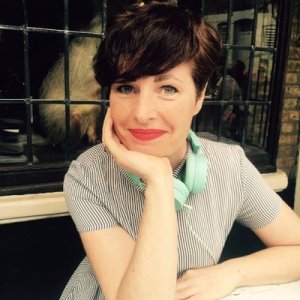 Aine McAllister is a poet from the Glens of Antrim, who works as a Senior Teaching Fellow at UCL IOE. She is currently completing an MA Poetry at Queens University. Her work is published in journals and she is working towards her first collection. She is interested in exploring how poetry gives voice and using dialogue as a tool for writing and for facilitating writing.
 Chris Murray