World Put to RightsThe dream that burst riverbanks Your plummets spraying wetness The church spire grew legs, scaled bricks, Quiet-huff of your refuge, to the realms of purity; You would sleep outside, would sing, Float on, keep your whistles of World Put to Rights is © Kelly Creighton , all rights reserved. . Kelly Creighton/ Ceallach O Criochain is an Irish artist, writer of fiction and poetry; born in Belfast in 1979 she writes about contemporary relationships and local landscapes. Kelly has previously published poems and short stories in anthologies and magazines.Currently her poetry is in literary ezines including A New Ulster, Lapwing Publications. Recently her work was feature of the week in Electric Windmill Press.Kelly is editing her novel Yielding Fruit, a historical fiction set in West Yorkshire, she is also compiling her first collection of poems. |
Category: Alphabets
-
-
 Nuala Ní Chonchúir
is a writer and poet, who has contributed poems and translations to the blog over sometime. I am linking here to her poetry collections page
La Pucelle
In the hush of my father’s house,
before dusk rustles over the horizon,
I take off the dress my mother made
-it’s as ruby red as St Michael’s cloak-
and with a stitch of linen, bind my breasts.
By the greasy light of a candle,
I shear my hair to the style of a boy,
in the looking glass I see my girlhood
swallowed up in a tunic and pants,
I lace them tightly to safeguard myself.
My soldiers call me ‘Pucelle’, maiden,
they cleave the suit of armour to my body,
and know when following my banner
over ramparts into Orléans, that
there will only ever be one like me.
When the pyre flames fly up my legs,
I do not think of the Dauphin,
or my trial as a heretical pretender,
but see my mother, head bent low,
sewing a red dress for her daughter to wear.
As Tatú, le Nuala Ní Chonchuir, Arlen House, 2007.http://poethead.wordpress.com/2009/06/13/la-pucelle-by-ni-chonchuir/
 Eithne Strong
“(née Eithne O’Connell) (1923-1999), poet and writer of fiction. Born in Glensharrold, Co. Limerick, she was educated at TCD. She worked in the Civil Service, 1942-3. Her first collection, Songs of Living (1961), was followed by Sarah in Passing (1974), Flesh-the Greatest Sin (1980), Cirt Oibre (1980), Fuil agus Fallaí (1983), My Darling Neighbour (1985), Aoife Faoi Ghlas (1990), An Sagart Pinc (1990), Spatial Nosing (1993) and Nobel (1999). The Love Riddle (1993) was a novel.”
from http://www.answers.com/topic/eithne-strong#ixzz1xr4mc0lx
Strip-Tease.
A poet
must talk in riddles
if he will not risk himself
for fear
of public eye and tongue
blaspheming privacies :
a host
of leeches sucking parallels
carnivores to strip his shivering secrecies
wrapped
intricately. he should be
silent or speak out.
No one
asked for
his arbitrary offerings.
from Sarah in Passing , by Eithne Strong. Dolmen Books 1974.http://poethead.wordpress.com/2011/03/19/strip-tease-by-eithne-strong/
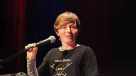 Sarah Clancy
Phrase Books Never Equip you for the Answers
On the morning of the fifteenth time we went through
our sleep-with-your-ex routine, I had the usual optimism
thing about mistakes is to not keep repeating the same ones
I said disregarding the government health warning
on the cigarettes I was sucking, crossing the road without
stopping speaking or looking, ignoring the red man pulsing
on the lights at the junction, I was wired direct and I said;
I know, I’ll write you the definitive user manual for me.
You said I was arrogant that we should make it up as we go,
and I said; well could I do a mind map then? With
here be dragons marked clearly in red, so we won’t flounder
like last time end up washed up dehydrated and drained
well I was, fairly wired, I said ‘in each shipwreck we’re lessened
embittered, come on, let me at least try to fix it, I can write us
a blueprint for the new improved version, and you laughed
and said well damn you for a head-wreck, go on then and do it.
So I wrote, but it came out all stilted, like a work in translation
see when I say, let me fix that or give it here and I’ll do it
it means I need you, and if I tell you for example how
I’ll re-arrange the universe to your liking it doesn’t mean
I’m superior in fact, translated it’s about the same as the last one-
‘can you not see, how I need you? And when I come out with all those
‘you-shoulds’ that drive you demented, there’s no disrespect in ‘em
verbatim they’re whispering I’d be desolated without you
and when you call me control freak, the tendencies you’re describing
are inherently rooted in my fear of you leaving and how I’ll react.
Less-wired more hopeful I brought you my phrase book
on our very next meeting but you kissed my cheek and said
let me stop you a minute and then those awful words that never
signify good outcomes, listen I’ve been thinking… I know
we’ve got this weird cyclical attraction thing going and I’m sorry
for my part in it but really I can’t see it working, the problem
for me is how you just don’t need anything and my phrase book
had nothing listed under that heading.© Sarah Clancy
Thanks to Sarah Clancy for the poem, Phrase Books Never Equip you for the Answers , which is taken from Thanks for Nothing Hippies . Published Salmon Poetry 2012.
 Kate Dempsey
Kate Dempsey’s poetry is widely published in Ireland and the UK including Poetry Ireland Review,The Shop, Orbis and Magma. Kate blogs at Writing.ie and Emerging Writer .
You can catch her on Twitter at PoetryDivas.
It’s What You Put Into It
For Grace
On the last day of term
you brought home a present,
placed it under the tree,
a light, chest-shaped mystery
wrapped in potato stamped paper
intricate with angels and stars.
Christmas morning
you watched as we opened it,
cautious not to tear the covering.
Inside, a margarine tub, empty.
Do you like it? eyes huge.
It’s beautiful.
What is it, sweetheart?
A box full of love, you said.
You should know, O my darling girl,
it’s on the dresser still
and from time to time, we open it.”
© Kate Dempsey, all rights reserved.
 Celia De Fréine
Celia de Fréine is a poet, playwright and screenwriter who writes in Irish and English, her site is at http://celiadefreine.com/
An Bhean Chaointe
Taim ag caoineadh anois chomh fada
agus is chumhin liom
ce gur dócha go raibh me óg trath-
seans fiú amháin gp mbinn ag súgradh.
Ni cuimhin liom an t-am sin
ná an ghruaim a chinn an ghairm seo dom.
Ni cuimhin liom ach oiread
éinne den dream
atá caointe agam-
ní dhearna mé taighde ar a saol
ná nior léigh mé cur síos orthu
i gcolún na marbh.
Ach is maith is eol dom
gach uair a sheas mé
taobh le huaigh bhealschoilte,
gur chomóir me gach saol
go huile is go hiomlán,
gur laoidh mé éachtaí
na nua-mharbh
is gur eachtaigh mé
lorg a sinsear.
Tigím anois
go bhfuil na caointe seo
tar éis dul in bhfedhim orm.
Dá mbeadh jab eile agam
ba bhreá liom bheith im scealaí-
sui le hais na tine is scéalta a insint.
D’éistfeá liom- tharraingeodh
d’Eddifon asam iad
á n-alpadh sa treo is go slanofaí mé.
Faoi Chabáistí is Ríonacha, Published by Clo Iar-Chonnachta, indreabhán, 2001.
-
Recently, I wrote a post about how government bodies tend to view poetry. Indeed, I would say their view tends toward jaundiced misunderstanding rather than outright aggression, but I could be wrong. The image embedded in the piece was of a woman placing flowers at Ted Hughes‘ memorial stone in Poet’s Corner at Westminster Abbey.
Ted Hughes’ stone was placed in close proximity to that of T.S Eliot‘s in the Abbey. Eliot, the banker, the poet, and the editor of Faber and Faber mentored and supported Hughes throughout his career. Eliot’s writing was of the monumental type, and clearly directed to posterity, it lacked intimacy. I will admit that I do like Eliot. Especially in his play, Murder in the Cathedral. I have for years tangled with the voices of the women, the chorus. This then is poetic-posterity. These women of Canterbury are doom-sayers, they are the Greek chorus. They are ignored and later chided for their melodramatic utterances. They are however heard and regarded by the martyr Thomas À Becket. I have added a section of the recording here for those interested in how T.S Eliot used the women.
I find it quite difficult to relate to women characters that are written by men, as there is an absence somewhere that I regard as experiential. I think maybe that Anna Livia Plurabelle by James Joyce has a similar resonance to the Canterbury women written by Eliot. There is a quality of universalism in words mouthed by women, but written by men. The woman’s experience and perspective is absent, this hardly matters to a newspaper commissioning editor or poetry editor, as they believe that a male poet can voice a woman’s experience just as well as the woman could herself. And therein lies the problem: the established male writer in whom a lot of money has been invested is likely better than a woman writer at things because he has been put on a plinth by the old boys and there he will stay head-stuffing on all subjects for a bored media who hate the arts anyway. He can even aspire to the godly and they will lap it up and reward it.
Posterity seems to have increasing importance to those writers who have criticised Carol Ann Duffy in recent weeks. It took 341 years for the English people to countenance a woman laureate, then her laureateship is attacked by the guardians of poetic dogma, who not once sought to define (say) Ted Hughes’ Laureateship,
“Conversely, Carol Ann Duffy’s work which speaks so clearly to many today may seem stale to posterity. I have no idea whether this would distress her.” (Allan Massie)
The idea of poetic posterity being defined by intellect is risible. The life of a poem is defined by the resonance of the image (or images) that are captured within the form of the poem. It is not a question of the perceived intellect of the poet, but of how the poem illuminates the reader. Nuala Ní Dhomhnaill‘s images are fine hewn and unforgettable, as are Plath’s, as are the images created by Anna Akhmatova, by Margaret Fuller, by Stevie Smith, or by Ágnes Nemes Nagy. The fact that a certain coterie of critics are glued to the idea of posterity whilst mistranslating the idea of popularity (or populism) wholly misses the point of poetry. It is not about how wordy and intellectual the poet, but how the poetic image can adapt and move with the reader through their lifetime and be always different and always challenging.
Government appointed funders do not recognise the place of poetry in our post-literate society. Political artifice dominates popular media and culture. I have never been so bored with the empty drone and bitching of it. I have never understood why men in suits whose drone tone shows a spectacular boredom are mirrored by a craven and fussy media. Evidently boredom is de rigeur for the modern male. It’s a mystery to me why people glue themselves to televisions watching the latest bitchy power struggle or political scandal. Their words are dead wood and they reek of impotence to be frank about it.
I am adding here two excerpts of poems/prose which I will properly attribute next week. I want the reader to investigate the images and form therein, and then possibly wonder at how stupidly gendered and egotistical the intellectual poets’ profound disconnect with their reader actually is become.
Poetry and Poetic Prose, two excerpts.
Excerpt #1.
Trees
Learn. The winter trees.
Hoarfrosted crown to root.
Immovable curtains.
.
And learn too of the zone
where a crystal steams
and trees merge into mists,
as the body in recollection of it.Excerpt #2
Travels
I.
I came to a land where freedom had been realised or was at least believed to be very close to its full realisation. For the people here the word freedom could consequently not be applicable to themselves but only to other peoples who had not yet discovered the happiness-making formula that means the realisation of freedom. In this land,therefore, the people talked much and with a strong sympathy for all the people beyond the frontiers of their own land who were not free. It was said that one ought to exert oneself to the uttermost in order to liberate all the lands and peoples of the earth. On the other hand, it would hardly have been the right thing if it had occurred to some compatriot to longingly, invoke, for example, the concept of freedom in an internal context to himself or any of his fellow-countrymen. To be sure, it was not forbidden by law to use the word freedom in that last-mentioned way, but a universally sanctioned convention in reality liquidated the word from any contexts other (than) external ones.
Since everything in this land was so new, so thrillingly and inspiringly new, I became like a child, reborn, receptive and avid for knowledge, and also became involved in teaching in a school. By day and by hour I received proof which confirmed that freedom really was being realised in this land as in no other. On the way to work, in buses, trams and underground trains the workers sat studying books which promised them the chance of experiencing freedom completely realised in their own lifetimes; a mother married to a simple sailor told me with eyes moist from emotion that there was every reason to expect that her son would attain the rank of admiral one day, and everywhere there was testimony to the fact that here women were acknowledged as beings equal to men with all their human rights acknowledged; among other things the fact that within the military profession they possessed the rank of captain, major and even colonel.”
EDIT 18/02/2012:
Excerpt # 1 was Trees by Ágnes Nemes Nagy , from Between Dedalus Press (Dublin) and Corvina Press (Budapest) 1998. In translation by Hugh Maxton.
Excerpt # 2 is by Mirjam Tuominen , The short prose Travels , is from Theme with Variations, published in 1952.
Murder in the Cathedral , the women , http://www.youtube.com/watch?v=MxA_3qyN1lk
T.S Eliot and the death of poetry , http://poethead.wordpress.com/2011/12/08/t-s-eliot-and-the-death-of-poetry/

‘Posterity and all that‘ by C Murray/Poethead is licensed under a Creative Commons Attribution-NonCommercial-NoDerivs 3.0 Unported License.
Based on a work at poethead.wordpress.com. -
This post is a short form critique based on recent media coverage of those women poets who had not alone dared to hoist their poetic-petards, but to have achieved a popularity which is altogether more meaty than winsome domestic. Last week, I alluded in my Tweets and indeed in this blog to the issue of poetic critique. I am taking the idea of critique a step further now, and examining the acreage of press devoted to a negative representation of women poets that somehow manages to generate column inches but ignores the actual material : the poems that the women write.
Unlike Rita Dove, Helen Vendler, and Alice Oswald, Carol Ann Duffy has (this time) escaped the pariah-like status conferred on women poets by a media more interested in looking for gossip than adequately reviewing their books. The recent rows between Dove and Vendler, have, I believe, been generated by a bored media that needs to play fire with the writers rather than examine the middle ground in what has become a race row. Very few editors looked at the Dove/Vendler row in its proper context; anthologies nearly always involve controversial choices. Nope! Far better to have a bit of mud-wrestling between two women editors of great merit, than to question the limits on their editorship, or why indeed so few women attain the level of literary acceptance to achieve an editorship in the first place. It is all about the row between the women, and not the relative merit of the two women’s work and what they both have contributed to literary America.
Alice Oswald had the temerity to withdraw from the T.S Eliot prize, and for this acres of column were devoted to examining the finances of poets and the perceived silliness of her principles. The issue of her withdrawal even made it into a paragraph in the Loose Leaves column of the Irish Times. The book itself, Memorial, has not achieved a critique within some of the very papers that reported her withdrawal from the T.S Eliot prize. Memorial apparently has no merit for the poet critic, but the row is highly important to the people who collate the gossip inches. Of course I thought to add in here the link to the poet’s protest about the ACE 2011 funding cuts.
Is this is what it is about ?
Women’s poetry becomes a reductio ad absurdum in terms of what editors consider to be marketable variety, whilst also ignoring the books, the work and their devotion to their medium? Where is the discussion on the Iliad, the discussion on the merit of editors like both Vendler and Dove ? I am only glad that commissioning editors in these cases actually mentioned the books, I’ll do my own reviews and reading rather than be led by low gossip mongers and silly headlines.
The question of the visibility of women writers raised by Boland in God’s Make their Own Importance can indeed be qualified with ‘maybe sometime they will actually review the books of those authors that they so casually traduce in their (er) newspapers‘.
Edit January 20/01/2012: More incisive critique in the London independent today by Boyd-Tonkin, using a stock-image of Alice Oswald, and of course reminding the reader that T.S Eliot was a banker (as the Telegraph did in December 2011)
EDIT January 31st 2012 : Some incisive Sir Geoffrey Hill nonsense, courtesy of the Telegraph http://www.telegraph.co.uk/culture/books/booknews/9050038/Poet-Laureate-compared-to-writers-of-Mills-and-Boon.html
Women Poets from the Blog (page)
Cutting the cloth to fit the wearer, recent press about women-poets. by C Murray is licensed under a Creative Commons Attribution-NonCommercial-NoDerivs 3.0 Unported License. -
The pictured editions carry a huge poetic punch, though it would be unfair to compare them as like. The Moth Little Editions were released this month, the Ginsberg is pre-1960 and Hannah Weiner’s books as objects of art were made in the 1970/80s. They are all serious books in small form, a virtue of City Lights and other makers of accessible arts books.
This post was advised by a brief Twitter discussion on portable poetry, such as the carrying of T.S Eliot‘s Four Quartets about for reading.
Quite recently I was genuinely amazed to receive four poetry books nestled within one (white) standard office-sized envelope from Moth Editions , and although the books are small they each contain 32 poems. This post is about physical books rather than about code , or indeed the storage and the dissemination of poetry through sites like Kenneth Goldsmith’s UBUWEB, which I have referred to before now here. I carry books around in a variety of bags, in fact , the type of bag I will choose for a day is never dependant on as a fickle a thing as fashion , but upon how big a bag I will require for a notebook , diary, boo , ( mostly poetry or biography), and pencil-case and letters (yes letters , I write those).
Poets Dermot Healey, Kate Dempsey, Ted McCarthy and Ciarán O Rourke form the quartet of poets that make up the first of the Moth Little Editions, I had introduced two of Dempsey’s Poems from the series quite recently.
Of course distillation and new formats can lead to the strangest of visual concentrations, such as using QR Code to bring a whole new audience to writers, including to Herman Melville and James Joyce. In the fictional sense, the creation of a Babel Library has it’s own interest and weird beauty. This post is about the mobility and adaptability of small texts, and how wonderful it is to be able to choose a good book like the Four Quartets to bring out with one to read !
The beauty of poetry is that it is highly adaptable to both book and technology formats and thus very versatile.
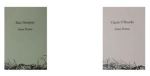
moth magazine’s ‘little editions’ 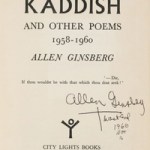
Ginsberg’s Kaddish (City Lights) 
‘Little Books/Indians’ by Hannah Weiner -
You will remain an example
(To Gandhi)
Translated from the Arabic by Ghias Aljundi. Tal Al-Mallouhi
I will walk with all walking people
And no
I will not stand still
Just to watch the passers-by
This is my Homeland
In which
I have
A palm tree
A drop in a cloud
And a grave to protect me
This is more beautiful
Than all cities of fog
And cities which
Do not recognise me
My master:
I would like to have power
Even for one day
To build the “republic of feelings.”
This is a reposting of Tal Al-Mallouhi’s You will remain an example, dedicated to Gandhi. Tal’s story is linked here.
There is another post which I wish refer to in brief, it is called Books written , ‘The Library of Babel‘ and it is by Borges. This short fiction from Borges’ Labyrinths, describes a mythological library of great density, proportion, and uniform. The library exists ab aeterno , from the eternal.
It contains everything ever written, expressed , or conceived in all languages, including , ” false catalogues and the demonstration of the fallacy of those catalogues.” The link I have included in the second short paragraph of this post looks at the design of the fictive Babel Library.
I like to think of it as an almost entirely true tale , as so many books of wisdom have been destroyed or made inaccessible by people who find human thought to be an inconvenience to their wishes and plans. The narrator of the library is an old man, who intends to die there amongst the books, he recounts his searches, his attempts to translate the orthography of the library and his relation to books in the piece.
A good friend in Catalunya once wrote an amazing piece on book-burning centred in the celebration of St Jordi’s Day, when people give to each other books and roses. I have not his excellent writing ability, but I do tend to believe that the books not written in this instance, will not stop her words emerging or her book from existing.
Words when uttered and written cannot not be taken back and must have their effect. There is something wholly infantile about banning and brutalising a youthful poet, I think it may be because the words used to commit the brutalisation have become empty of their validity and symbolism for a great many people. The same goes for those people who wish to censor the great Walt Whitman from classrooms in CA, you do not encourage critical discernment by labelling books of genius as ‘bad’ because the singer of the poems was gay!
-
“These performative dimensions of public speech always carry tones, gestures, forms of acting out, contradictions, and self-corrections that contribute to new actions and capacities in others. The quote you have singled out to me suggests that poetry can show engaged citizens how to listen to, or respond to, public issues or actions.”
The above statement is about poetic engagement derived from a piece at J2, entitled Recasting poetry, the long biography of a poem. (at Link) . It is interesting indeed how writers use the internet and multi-media resources for poetics , but this piece is not about practice or gesture, it is about creating poetic spaces in the most public of places, the web. I saw this republished Atlantic article last week and wish to set this short post into that context.
Lots of readers will note the allusion to Virgina Woolf’s statement about writing spaces in the title of this post, indeed we know all about the oubliettes, the locked-doors, the time stolen or negotiated that forms the woman writer’s battle for self-expression. There are also varieties of instances of perceived adulteries caused by women musing upon their muses, written most poignantly by Mirjam Tuominen which could have net-applications… I may link that one soon.
I am concerned now with the issue of public writing, with space, and with the diary form translated and updated to the web blog form, and in how that impacts upon the practice of writing, specifically mine. I recently wrote a piece about writing practice ( for another blog) on the subject of transcription, which set me to thinking about how my writing practice has changed. There is an awkwardness about my left-handedness which does not lend itself to copying and pasting much, and most of the poems on this blog are transcribed directly from books, except the original works which are just written down and eventually typed out. However, I do a lot more in the way of communicating than I necessarily would just sitting in a room reading and writing (or doodling).
It has been excellent in many ways to be able to access other writers and discuss subjects such as poetry, gender, women’s presence online and imbalances in publication of women writers , most particularly literary women writers.
What hasn’t been excellent is that the scrawled jotting, associative thinking, and lateral imaging things are a bit neglected. No matter how much one refuses to admit it, blogging is a very public method of getting to the essentials of writing, it has its own space, time and decorative element. Blogging has rather severe limitations in terms of tailoring what one thinks people wish to read, and it is not a spontaneous or creative way of writing.
This very public space which is defined by what I want to go on the page lacks a creativity that is often exasperating, I don’t doodle here, or cross out things. Poems that I like or think others may like are what this space is about, it does not have the busyness of sets of inter-related note-books, folders, pencil-cases or writing smells like inky leaks. It is too neat. I am looking for ways to make it more natural at the moment.
One thing which annoys me beyond anything else about women who write is their constant referral to themselves as scribblers and not as writers. The two acts, that of writing and that of scribbling are not really related, scribbling is more a mode of generation than of production. Very few male authors tend toward that type of florid self description.
-
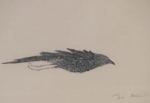
‘Bird in the Sun’, by Leonard Baskin. Willy-wag and Sparrow
sat on a stone.
Said Willy, it’s cold
when the sun is gone.But my heart beats hot
in my white silk breast;
time enough later
for me to rest.Said Sparrow, It’s dark
in the green willow,
and the cat may lurk
in the shade below.He fluffed his feathers
and shook his head;
by now the others
are safe in bed.Said Willy, the sky
is full of light,
and a juicy fly
is quickly caught.I’ll flirt my fan
awhile the cold,
and I won’t go in
till the moon is gold.Said sparrow, the tree
is full by now,
and I’m off to my perch
on the topmost bough.But Willy said, whether
it’s dark or light,
if I feel like singing
I’ll sing all night.By Nancy Cato
In remembrance of the children of Utoeya, whose play was so grievously wounded and destroyed. RIP
From The Dancing Bough, 1957.
Linked here : http://www.poetrylibrary.edu.au/poems-book/the-dancing-bough-0063000
 Chris Murray