Roxy
Bonny Sandy breaks my heart
no coming to couch the night
& his blade red wine
& his thrapplejammer white wine
bonny Sandy brooks my hurt
this ae night
ilka night
& the horns of young green wine
bonny Sandy brakes his hart.
Love whinges & crines. The bonny knight
in ague sweat & his ain shite, unhurt.
© Kit Fryatt, all rights reserved.
nanna slut’s long close summer
Dance the lamb
ra-ra
lamb
ra-ra
mutton hunks
It’s a shame the way we carry on
The streets stink tonight; my skullpan’s pounding
for rain or riot, I’m not so young, scarred from mound
to sternum, childless pale citadel of bravado and competence;
though if it gets too tasty I’ll hitch my mobile home
and flit this meatpacking warehouse district
but for now I’m hanging in there, for a sniff at the grinding bliss
the brazen looter children have, this year’s corn kings─
with sordid cold, blanket, galvanise tray, comes the morning in.
Dress the lamb
rare-rare
rare-rare
mutton bird
It’s a shame the way we carry on
Come sisters, these Lammas shiftless we could use, straw
men to our hags, the blintering braggarts will fight our wars
and decorate our palaces, symbolize in their dying
everything that comforts people, and stupefies.
The estate we lost thirty grand years ago, tonight we take
ground, we rise, inhale, we’re scary cunts, tonight we tear
spoil through locked wards, mindless, knowing that
our chicken limbs may splinter, falter; like, a freedom act
like, do whatever you want
mate
do
the mutton flap
It’s a shame
© Kit Fryatt, all rights reserved.
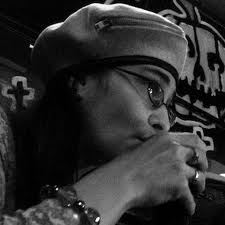 Kit Fryatt writes and performs poems at Spoke, Wurm in Apfel and Can Can. I met her at the Mater Dei launch of Post III Magazine and being well-impressed with a card-carrying poet, I begged some poems for my Saturday Woman Poet blog. I got three unpublished poems , which would be considered over-generous, so I am publishing two of them today and returning the third with the proviso that if they are published online, they are Published work. Thanks to Kit for her generous contribution to Poethead. Copyright of the above poems remains with the author.

Two Poems by Kit Fryatt is licensed under a Creative Commons Attribution-NonCommercial-NoDerivs 3.0 Unported License.
Based on a work at wurmimapfel.net.


 Chris Murray
Arts Practice is in it’s essence is based in creativity, hence the need for the artist to be aware of how copyright works
The ability to set creative commons licences is crucial to artistic activity, I discussed here : http://poethead.wordpress.com/2011/03/23/poetry-and-digitisation-how-derivatives-occur/
Derivatives in poetry include translation, adaptation (including film/theatre/music/ artistic image) Artists have been using gnu/cc *for a generation* based in their awareness that the arts seed ideas, and that the artist /originator retains the moral and intellectual rights to ownership of their work through the setting of permissions.
I appealed to DETI in my first submission (June 2011) for recognition of the arts based in conventions (including Berne) and ongoing manifesto discussions on the issue. The current base of CRC discussion is narrow and not cognisant of how artistic practice would be impinged by a top-down regime of copyright law. The parameters of discussion need be widened to look at the originators of works in how they expect and understand how their work is used by other artists.
In example, I only use cc (by-NC-ND) for original works and I only publish previously published works on my blog, because I cannot afford remedy in law if ripped off- thus a tiny % of my material is online because of self-restriction : balance this against a corporate entity and their resources. there is a disparity inherent in legal remedy based wholly in resource at the moment. Add to that the issue of loss : if DDoS or any other denial of service occurs (incl isp-blocking) I lose three _ to four years of writing _ again my original work, and it is not subject to remedies that are affordable.
Artists need assurances and laws that protect their works and rights, these laws must be cognisant of their right to set permissions and to have confidence in methods of transmission. The base for copyright discussion needs to include and involve those advocates with expertise in the area and this is not confined or should be weighted to business and corporates.
If the base of copyright discussion is not broadened to include arts’ practice it is a creative disservice to Irish arts, and a refusal to recognise creative practice including those mentioned above : translation, adaptation , visual art and film.’ (my quote)
I will add links to how the issue of fair-use and rights-holders are being discussed in the comments section. I hope that people who publish online recognise themselves as stakeholders and desire to contribute their expertise to the CRC2012, because as stated in bold above here, ‘ The base for copyright discussion needs to include and involve those advocacies with expertise in the area and this is not confined or should be weighted to business and corporate entities.’