Trees Trees by Ágnes Nemes Nagy, from Between , Selected Poems of Ágnes Nemes Nagy, translated by Hugh Maxton, Corvina Press , Budapest and Dedalus Press , Dublin. 1988. |
Category: How Words Play
-
-
‘I am an Irish poet. A woman poet. In the first category I enter the tradition of the English language at an angle. In the second, I enter my own tradition at an even more steep angle. I need to be candid about this because, of course, these two identities shape and re-shape what I have to say today. The authority of the poet – that broad and challenging theme – is really, in my case, a series of instincts and hunches. The difference in my case, is that while many poets look to the past for the story of that authority, I no longer do so. I have stopped listening to the story which grants automatic authority to the poet and automatic importance to the poem. Instead, I have come to see a suppressed narrative.’ (Eavan Boland)
I have often wondered at the angle that Eavan Boland speaks of in this excerpted speech from the PN Review. The speech entitled Gods Make Their Own Importance was delivered in 1994 under the auspices of the Poetry Book Society. Eavan Boland revisited a variation on this theme in 2007 when she interviewed with the Boston Globe. I know that its a bit impertinent to extract a blog post from the two linked pieces, but I thought to examine the idea of contemporary women poets taking on larger themes, rather than those small and domestic things so indicative of the lesser space which Eavan Boland discussed.
The Boston Globe article, Exploring Poetry’s Lesser Space (2007) is as relevant now as it was at the time and maybe more so. A critical review of poetry is either absent or confined to particular little corners here in Ireland. I can take some recent examples of this absence which I have published here on the blog, the Irish Times Books of 2011 did not allow for a single poetry publication, for instance. I have (to date) not seen a review of Oswald’s Memorial in our papers of note, or indeed in any of the Irish newspapers. Lucky then that good reviews are available elsewhere for lovers of poetry and non-fiction. Some people take the idea of a non-fiction readership seriously and cater then to a less limited spectrum of reading tastes and experiences. I am linking Michael Lista‘s National Post Review of Oswald’s Memorial.
If a male author of our very small writing establishment had stripped down The Iliad and had written a powerful dirge as Oswald has undoubtedly achieved in Memorial, would it have made it to the end of year book lists? I do not think that the issue regarding the provision of space for readers of non-fiction and poetry is the problem, the problem appears to be based on the marketing of books. Oswald’s withdrawal from the T.S Eliot prize was noted in the Irish Times and indeed in the Irish Independent, but there is as far as I can see no review of the actual book on either website. Is it considered unladylike for women poets to take on vast themes that are decidedly not domestic celebratory, and thus not interesting to reviewers?
In 2010 VIDA (Women in the Literary Arts) published The Count, which showed a truly abysmal lack in critical review of women literary writers and poets. I feel that 2011 has been better for women in literature, although there are as yet no published figures available. I have to wonder if a lack of critical and intellectual reviews of poets like Alice Oswald is based within the same confined dogmatic parameters that Boland alluded to in the linked lecture and interview. The small poems of the domestic, the novels, and some genres seem open to review and discussion, but the larger themes are passed over and ignored. There appears to be a lack of balance inherent in how certain genres are presented to readers of literature, which reflects a small coterie of male-writers and their special interests. Although, it just might represent how poetry is perceived and marketed in Ireland and the UK.
Of course, it could be simply a matter of impatience on my part to see what reviewers make of books by women writers that exist outside of the poetic lesser space and its artificial confines. I do not see contemporary women reviewers or women critics asking the questions that Eavan Boland did in 1994 or indeed in 2007. My assumption that the issue of how we look at women literary writers and poets in Ireland must have been resolved satisfactorily without my noting it,
Or
it could be entirely presumed that women reviewers really do not give much of a fuck about Irish literature unless it exists within the cut-out pattern that they are entirely comfortable with. Reviewing the same consistent group of books within the same confining parameters that please their mostly male bosses for a small group of writers who accept a formulaic critique as a matter of course. The same publishers in the tiny stagnant pool of Dublin-centric art luvviedom: how boring, how narrow – how idiotic. How utterly failed is Irish literature when critical reception amounts to cut-out doll pattern that attempts market influence. Serious poetry and non-fiction readers may have to look elsewhere for cogent and interesting reviews of poetry books written by women.
Related Links
-
Má chuirim aon lámh ar an dtearmann beannaithe,
má thógaim droichead thar an abhainn,
gach a mbíonn tógtha isló ages na ceardaithe
bíonn sé leagtha ar maidin romham.
Tagann aníos an abhainn istoíche bád
is bean ina seasamh inti.
Tá coinneal ar lasadh ina súil is ina lámha.
Tá dhá mhaide rámha aici.
Tairrigíonn sí amach paca cartaí,
‘An imréofá brieth?’ a deireann sí.
Imrímid is buann sí orm de shíor
is cuireann sí de cheist, de bhreith is de mhórualach orm
Gan an tarna béile a ithe in aon tigh,
ná an tarna oíche a chaitheamh faoi aon díon,
gan dhá shraic chodlata a dhéanamh ar aon leaba
go bhfaighead í. Nuair a fhiafraím di cá mbíonn sí,
‘Dá mba siar é soir, ‘a deireann sí, ‘dá mba soir é sior.’
Imíonn sí léi agus splancacha tintrí léi
is fágtar ansan mé ar an bport.
Tá an dá choinneal fós ar lasadh le mo thaobh.
D’fhág sí na maidi rámha agam.Geasa le Nuala Ní Dhomhnaill, as Pharaoh’s Daughter. Gallery Press. 1990. This poem is from Pharaoh’s Daughter by Nuala Ní Dhomhnaill, 1990, Gallery Press (Editor Peter Fallon). With thanks to Gallery Press for permission to reproduce here. I have added poet Medbh McGuckian‘s translation at link
The Bond, by Nuala Ní Dhomhnaill, translated by Medbh McGuckian.
-
If I use my forbidden hand
To raise a bridge across the river,
All the work of the builders
Has been blown up by sunrise.
A boat comes up the river by night
With a woman standing in it,
Twin candles lit in her eyes
And two oars in her hands.
She unsheathes a pack of cards,
‘Will you play forfeits?’ She says.
We play and she beats me hands down,
And she puts three banns upon me:
Not to have two meals in one house,
Not to pass two nights under one roof,
Not to sleep twice with the same man
Until I find her. When I ask her address,
‘If it were north I’d tell you south,
If it were east, west.’ She hooks
Off in a flash of lightning, leaving me
Stranded on the bank,
My eyes full of candles,
And the two dead oars.
This is a translation of Geasa, by Nuala Ni Dhomhnaill. The poem is from Pharaoh’s Daughter by Nuala Ní Dhomhnaill, 1990, Gallery Press (Ed. Peter Fallon). With thanks to Gallery Press for permission to reproduce here. - This translation of Geasa is by poet, Medbh McGuckian
- Geasa
-
Sonnet
I can’t sleep in case a few things you said
no longer apply. The matter’s endless,
but definitions alter what’s ahead
and you and words are like a hare and tortoise.
Aaaagh there’s no description — each a fractal
sectioned by silences, we have our own
skins to feel through and fall back through — awful
to make so much of something so unknown.
But even I — some shower-swift commitments
are all you’ll get; I mustn’t gauge or give
more than I take — which is a way to balance
between misprision and belief in love
both true and false, because I’m only just
short of a word to be the first to trust.by Alice Oswald from The Thing in the Gap-Stone Stile (Oxford 1996).
I am adding here the Library Thing link for The Thing in the Gap-Stone Stile by Alice Oswald. I wrote a brief polemic last week about the decision of the two poets , Alice Oswald and John Kinsella, to leave the T.S Eliot Prize, but I do hope that people will do their own reading on the issues surrounding their decisions. There are a some sonnets on this blog and a few of these are taken from the magnificent Norton Anthology, The Making of a Sonnet , edited by Eavan Boland and Edward Hirsch , which I’d recommend to lovers of the sonnet form.

-

The image is from this BBC report.
Poetry was once important as a part of our culture, and as an art.
This week , the Ted Hughes memorial-stone made headlines , it is sited near to T.S Eliot’s memorial-stone in Poet’s Corner at Westminster Abbey. I have linked the report above here. Unfortunately, T.S Eliot’s memory, and his work for poetry has reached the headlines for entirely different reasons this week. Two poets had withdrawn from the T.S Eliot Prize , as of Wednesday the 7th of December. Alice Oswald withdrew on the 6th of December, citing her ethical refusal to accept the sponsorship of Aurum (a hedge-fund group), she was closely followed in what amounted to an ethical boycott of the prize by John Kinsella on the following morning (7th of December).
The T.S Eliot Prize was targeted for ACE funding cuts in 2011 by the Conservative and Liberal Democrat Coalition, alongside nine other poetry publishers or groups. I blogged about this at the time, but I am adding here a Guardian report on the issue. It interests me that small groups dedicated to the art of poetry were treated with such disdain in England, although it happened in Ireland also (in 2010). Here’s a poethead post on same.
Those amongst us who read poetry and indeed the biographies of poets like Ted Hughes, Richard Murphy, T.S Eliot and others ( William Trevor) will be aware that the idea of poetry was supported by the BBC, by successive U.K governments and by the reading public. Poetry was a recognised art form, uncheapened by celebrity-status , or the red-carpet treatments meted out to the sorriest attempts at biography here in Ireland (for instance). I expect that this was because poetry’s place was recognised as having a literary value, which cannot be equated to a monetary-value.
When I looked at the Hughes memorial images , although it does not show the proximity of the Hughes and Eliot stones, I truly wondered if it were not actually poetry that was being memorialized as a literary-form ? Societies like the Poetry Book Society have for the current government in the U.K little or no value. I believe that the same thing is happening here under the aegis of the 2003 Arts Act which saw cuts to two Irish Writer’s Centres, and a city council cut to the Poetry Now Festival ! These festivals and centres provide the life-blood of small press buying and selling, and thus fund poets. There are quite a few pages and posts on this site about the unwonted closeness that exists between funders and politicians, which I believe was created in the 2003 Arts Act and that I discussed here. It would really be tragic if poetry as a form was set to cultural ossification because government (who support and appoint arts organisations) saw it as not a seller.
Already too much art is caught into utilitarianism here in Ireland, and what was not considered art is being supported by government in the form of tax-reliefs and other incentives. I do believe that we are gone quite topsy-turvy in how we read , or do not read, in this instance. I’d be scrutinising the lobby-groups that got arts money…..
BBC Film here : http://www.bbc.co.uk/news/entertainment-arts-16055750

T.S Eliot and the death of poetry by C Murray is licensed under a Creative Commons Attribution-NonCommercial-NoDerivs 3.0 Unported License. -
Post is a Review of Poetry Studies from the Irish Centre for Poetry Studies at the Mater Dei Institute , Dublin City University (D.C.U). The third issue of Post was launched this week, there is .pdf copy available to interested readers now available online, I have linked it at the base of this piece.

In Michael Hind’s editorial, Post III, and the poetry of sport sets the framework for the third issue, and puts some difficulties with it into their proper context. Contributors are Katelyn Ferguson on (Brendan) Kennelly on and off the blocks , Jonathan Silverman ‘trackside vigilance’, Christodoulos Makris , Stephen Wilson, Niall Murphy, Roy Goldblatt, Alexandra Tauvray, Ian Leask, and there’s even a review by me about Jeet Thayil’s selection of Contemporary Indian Poets for Bloodaxe.
Christodoulos Markis’ read from Spitting Out The Mother Tongue on the evening of the launch, and the poems are available in the Post III .pdf , Christodoulos’ blog is here . The above image is by Derek Beaulieu, I am also linking to his blog .
My contribution to Post III was to look at editor Jeet Thayil’s The Bloodaxe Book of Contemporary Indian Poets. I greatly enjoyed his approach to it’s editing which was of a non-chronological construction and was well-populated with women writers , who have stepped from behind the classical Indian constructs of beauty and silence to speak at last. I hope Jeet likes the review, as I have sent it to him (with some trepidation). Two of the women from the Bloodaxe Book of Contemporary Indian Poets have appeared on the pages of Poethead before now. I am linking Imtiaz Dharker’s site , as I have become incredibly fond of her writing as a result of the introduction she received in Jeet Thayil’s book. My review is on pages 130-134 of Post III.
,/tr>
I am adding here an excerpt from Imtiaz Dharker’s Living Space , Into this rough frame,
someone has squeezed
a living spaceand even dared to placethese eggs in a wire basket,fragile curves of whitehung out over the dark edgeof a slanted universe,‘Living Space ‘ , image and poem by Imtiaz Dharker.Poetry by Imtiaz Dharker is available at her website , and linked in at Poetry international Web . Thank you to Jeet Thayil who contacted me about the review of his book, and who appreciates my emphasis on the women poet’s emergence from behind the classical ( and often constructed) representations of women. I have published a brief link to Dharker before now, here.. -
Socrates in The Garden
In his world he moves,
January light fooling
this place into beauty –
broken glass glittering
on the flats’ side lane,
white graffitti translucent
on the school wall;
Pushers out!…Egg head…
Fuck off…Wanker Meehan.
Old shoes, their laces tied,
dangle over electricity wires,
beside pulled-apart phones
flung there, high above
burnt mattresses, gutted cars
and rusting bikes –
used needles jabbing the way
the children go to school.Parents yell,
their calls like cigarette ash
billowing out
in front of their washing
hung from shabby balconies,
the grandmothers busy below
with Moore Street prams piled
with fruit, football hats, lighters
fireworks and wrapping paper –
all the stolen seasons trundling
their way to the market
down roads Matt Talbot roamed
with drink, then manic prayer,
his chains the size of a horse’s trace
wrapped around his body
one hot June day,
where he fell on Granby lane.And in this world,
Margaret goes to get married
in a horse- drawn carriage
around Stephen’s Green.
All skin and bone,
pneumonia choking
her final days,
her name will become a ribbon
and light, on the Christmas tree,
an embroidered square
on a patch-work quilt
hung in a vast, cold place,
where the young priest
talks only to old women,
the wind outside blowing litter –
caged pigeons set free from rooftops,
rising up oblivious as Liffey gulls.In his world he moves,
his head slanted
against doorways,
his cheeks bruised
with the cut of a city night.
Hearing the cathedral chime
hourly, cheeky, melodic –
Three Blind Mice…
In Dublin’s fair city,
he queues at the soup kitchen’s door
choosing food
over the bell-ringer’s charm.
His hunger slouching
in second-hand clothes
against the city wall,
is so acute it sends
early morning nightmares –How the stained glass
in Nicholas of Myra cracks,
how Major Sirr rises from his grave
pulling St Weburgh’s apart,
strutting down Thomas Street to watch
Emmet’s delirium beheaded!
And sometimes into his world
you move, cooling his fever,
wetting his mouth
with fresh basil leaves
of hope, lifting his thoughts,
so that far away,
over the copper domes, lifting his thoughts,
so that far away, over the copper domes,
the shut-up, run-down flats,
he can see in the garden
Socrates –His toes cracked, his robe
thrown across shoulders
chipped with neglect,
part of his nose fallen lost
among polite glass-houses,
herbaceous borders
and Victorian signs.
But his stare is deep-eyed
and his thoughts are river sounds
original like rain
on this bright day.
He is finding a space for you both
in the otherwise wildof your mid-lives, letting
your hard city fall way
with each push of the gate
inwards to his green heaven.Run to his shape
the willow trees whisper,
Pull our leaves,
like hair from his face –
find his eyes staring,
questioning you.from Socrates in the Garden, Dedalus Press, 1998.
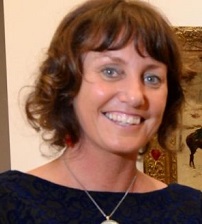 Enda Wyley is poet and children’s author. She was born in Dún Laoghaire, Co Dublin 1966 and currently lives in Dublin. She has published five collections of poetry: Eating Baby Jesus (1993), Socrates in the Garden (1998), Poems for Breakfast ( 2004), To Wake to This (2009), and Borrowed Space, New and Selected Poems (2014).
Her poetry has been widely broadcast, translated and anthologised including in, The Harvard Anthology of Modern Irish Poetry, USA (2010), The Wake Forest Book of Irish Women Poets, USA (2011), Femmes d’Irlande en Poésie, 1973-2013, ed Clíona Ní Ríordáin, Lines of Vision, The National Gallery of Ireland, 2014.
She holds a B.Ed with a distinction in English Literature, was the recipient of an M.A in Creative Writing from Lancaster University, was the inaugural winner of the Vincent Buckley Poetry Prize and has received many Arts Council Literature Bursaries for her writing. In 2014 she was the recipient of a Patrick and Katherine Kavanagh Fellowship for her poetry. In recent years she has been Poet- at -Work in the Coombe Maternity Hospital, Dublin and Writer in Residence at The Marino Institute of Education, Dublin.
Enda Wyley’s books for children from O’Brien Press are Boo and Bear and The Silver Notebook. Her book I Won’t Go to China ! was awarded a Reading Association of Ireland Special Merit Award 2011. Enda Wyley was elected to Aosdána in March 2015.
Enda Wyley Reviews
‘New and Selected’ seems the perfectly suited appellation for the work on offer here. Ms. Wyley’s poems are perpetually fresh, utterly scrutinized, marked by vigor and virtuosity, arriving on the page as accomplished things, like settled law, fit for the long haul language calls us to.’Thomas Lynch, Poet, 2014.
‘Enda Wyley’s poems are remarkable for the way they communicate warm feeling through their lightness of touch and clarity of colour.’
The trustees of the Patrick and Katherine Kavanagh Fellowship, 2014.‘Enda Wyley is a true poet. To Wake To This articulates a subtle, dreamy apprehension through a diction and an imagery all the writer’s own.’
Fiona Sampson, The Irish Times.‘Her imagery, honesty and insight make this a first rate work.’
Poetry Ireland Review.- http://aosdana.artscouncil.ie/Members/Literature/Wyley.aspx
- http://dedaluspress.com/authors/wyley-enda/
Published with the kind permission of Dedalus Press , Dublin http://www.dedaluspress.com/poets/wyley.html

 Chris Murray