|
|

The following two poems are by Sarah Clancy from a forthcoming collection of prose and poetry, called Friction.
Veracity and other stories Gullible. |
|
|
The following two poems are by Sarah Clancy from a forthcoming collection of prose and poetry, called Friction.
Veracity and other stories Gullible. |
A New Ulster Poetry and Literary Ezine
|
What distinguishes A New Ulster as poetry journal is evident also in Bone Orchard Poetry and in other Ezines that are led by artists and writers who respond with alacrity to a need for publishing platforms for new and established writers. When I started this blog five years ago, I did a yearly review of what is offered to the poetic writer in the way of publishing platforms. The developing commitment of literary editors to the usage of online tools, such as Ezines, BlogZines, online-publication, and adapting traditional publication was at an exciting point. Jacket2, Harriet the Blog (The Poetry Foundation) and Poetry Ireland were busily adapting to and testing the poetic waters, as was UBUWEB . Editors have been using social-media tools to ensure that poetry is read. I find it strange that there appears to be an inherent distrust of the medium in some quarters here in Ireland. Underutilisation of open-source systems and social media tools strikes me as a little ungenerous.
The years began providing exciting new magazines and platforms, an increase in poetic-writing is showing itself in publications like Burning Bush 2, And Other Poems, Anon Publications, Bare Hands and Southword, to name a few. The other side of the coin is how traditional publications are adapting to internet and using social-media to advance poetic writers and their audiences. It may have been bold to claim a poetic-renaissance but I am sticking to it, maybe others will catch up when they get their heads out of Miley Cyrus’ arse, who knows ?
A New Ulster a publishing platform led by Amos Gideon Grieg and Arizahn, is that wonderful poetic-hybrid of traditional and internet publication that uses a wide variety of social-media platforms to generate audience and writer alike. Because the publication is writer led, the editors bring in their skills as poet and fiction-writer, and their (hopefully not exhausted enthusiasm) for new forms and methodologies of communicating literature with their readers.
Poets featuring in a New Ulster include :
 |
untitled image , oil on canvas by © Michael McAloran 2003
histology slice 3
[ a tissue cloth so delicately coloured in mauves and purples indigo
and ivory cells become tissue whereas this isn’t at all the case
all is one in febrile disequilibrium not excluding momentary states
of euphoria and relative equilibrium the macabre beauty of histology
like a travelogue along enlarged detailed drawings of funghal spores
or sporoform zoophytes white exquisitely and hypersensitively drawn
by haekcle against a black CSO corps sans organes the hubris debris
humus against which lines flightlines maps nomadologic trails micro
politic events pointillistic gestes rhizomatic ghanaean junglean infra
branchings dadaistic or ba’akan pygmee refrains establish unfold
glare and disappear amongst glacis’ of ice basalt slate sapphire or
northsea grayness and mist histology is that : the slice with obsolete
or ephemereal or contingent a truth to leave the observor with her’s
his’s own ponderings of carcinogenic intimacy or clean tissue missive
towards the ones receptive the ones donating slices out of their body
to be mapped navigated coloured in mauves grays deep purples
to indigo ]
Text is © Aad de Gids
Stone weighting my palm
has sprung a cathedral
heart jumps
walking in the flesh of its surpassing grace
groin-vaulted and high as
no bird ever escaped to soar this
high-up—
seamless and
there is no blood
no feather
no bone—
stone cannot make the bird.
© C. Murray
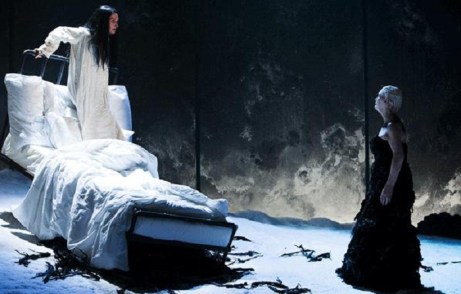
| Excerpt from Woman and Scarecrow by Marina Carr
Enter the thing in the wardrobe, regal, terrifying, one black wing, cobalt beak, clawed feet, taloned fingers. It is scarecrow, transformed. Stands looking at woman, shakes itself down, woman stares at it. Scarecrow takes woman’s hand, pierces vein in her wrist, a fountain of blood shoots out. Scarecrow dips quill into woman’s wrist. A cry of pain from Woman. Woman We don’t belong here. There must be Scarecrow You’re determined to go with romance on your lips. Woman I know as well as the next that the arc of Scarecrow It comes from the Latin, pati, to suffer © Marina Carr , all rights reserved Excerpted from *Woman and Scarecrow, published Gallery Press, 2006.
|
| Gallery Press celebrated their 43rd Anniversary in publishing this week of February 2013. Marina Carr is a playwright known to us for the excellence of her work. I was incredibly privileged to witness Marina read from her play Woman and Scarecrow in Galway during Gallery Press’ 40th Anniversary celebrations three years ago. I blogged about Carr’s reading here.
I am interested in how writers use the theatrical-space to create image and symbol, as much as I am interested in how poets use the theatrical-space for poetic works. Gallery Press publish both poetry and drama, thus I wanted to look at Marina Carr’s use of structure and symbol in Woman and Scarecrow. Thank you to Suella from The Gallery Press who has helped me to find the relevant sections of the play, and who has often aided me in the past with regard to permissions for hosting Gallery poets on this blog.
|
Of strangeness that Wakes us by Ilya Kaminsky
Published Poetry Magazine, January 2013. A Publication of the Poetry Foundation
Todesfuge, by Paul Celan is a poem that I have mentioned here on Poethead in a variety of guises since I first read the poet Paul Celan in Fathomsuns’ and ‘Benighted’ (Carcanet, Trans. by Ian fairley)
Later, I went on to acquire the book, Paul Celan Poet, Survivor, Jew by John Felstiner which has a chapter entitled, ‘A Fugue After Auschwitz (1944-45 ) /your ashen hair Shulamith’, detailing Felstiner’s approach to the translation of Todesfuge. I blogged my reading of Todesfuge here .
In many ways I do not feel as if I will ever finish with the reading of that poem. I feel that this blog space is too limited to write about Paul Celan and his dedicated translators including, Ian Fairley, Pierre Joris, and John Felstiner. However, when an interesting article or translation of Celan emerges I link to it here. Poetry Magazine (January 2013) has an article on Celan’s poetry, including some discussion of Felstiner’s translation of Todesfuge. The text of the Felstiner translation of Todesfuge is included in Of strangeness that Wakes us by by Ilya Kaminsky.
Here Kaminsky discusses Celan’s alleged hermeticism , which the poet himself denied. He looks at the issues of expressing the experience of the Jewish poet Post-Holocaust and at Adorno’s exhortation that ‘it is barbaric to write poetry after the Holocaust’.
Poetry had to be written after the Holocaust, as art had to occur. Weil or Tuominen would describe poetry written in cataclysmic times as a poetry of necessity.
The expression of the WWII diaspora poet in the great Todesfuge becomes, in Felstiner’s words an encapsulation of or/ the Guernica of Post-War European Literature. Those readers of Celan who come to Poethead to link to Celan’s works will be intrigued by Kaminsky’s discussion on Celan’s poetic-process, his approach to language, to the creative-process, and to his expressing of human catastrophe
On Felstiner’s translation of Todesfuge Kaminsky says,
‘In my private library, this is one of the great translations of the twentieth century. But the word “translation” to my mind is misleading. This translation (or any great translation, for that matter) is not a mirror. While one appreciates Felstiner’s haunting use of German words interspersed with English, this striking and powerful juxtaposition of languages doesn’t happen in Celan’s poem.’ (Of strangeness That Wakes Us )
The sheer brokenness of the mother-tongue in Celan’s expression is precisely what allows for linguistic multi-layering within a translator-approach to the poet’s work. It is precisely this that Felstiner divines and uses in his translation, and whilst it may not appeal to the purist, it is that seamless juxtaposition and use of the German that gives the Felstiner translation its evocative quality.
Get Poetry Magazine and read the entire Felstiner translation which is embedded into his wonderful article on Paul Celan.
Note: I linked a Pierre Joris essay on Paul Celan here in August 2010, regarding Todtnauberg , as well as numerous references to Celan’s work. Essays on Celan and his translators are too all-encompassing to limit to (or add to) existent blog-posts. I recommend that readers with an interest in Celan visit Poetry Foundation, Pierre Joris’ Nomadics blog, and Jacket 2 for further discussion on the work of Paul Celan.
 YouTube of Todesfuge.
|
I have spent my life
squeezing my fingers between
vibrating leaves of costal bone,
insistently scraping fascia
from muscle from nerve,
unhooking your sternum
from your throat,
prizing apart
the wedges of your spine
to reach that precious bag of blood,
to quell its chaotic pulse;
to jump back
as your thorax springs open
like an eye,
your heart
the wild pupil.
‘The Wild Pupil ‘ is © Kathy D’Arcy, from The Wild Pupil, published by Bradshaw Books.
.

Kathy D’Arcy is a poet, workshop facilitator and youth worker based in Cork city. Originally trained as a doctor, she is currently writer in residence with Tigh Fili Cultural Centre. Her second collection, The Wild Pupil, was recently launched in Dublin by Jean O’ Brien and in Cork by Thomas McCarthy. She has just been awarded an Arts Council Artists’ Bursary to support the future development of her work. info at http://www.kathydarcy.com/
|
Seed is taken from Mysteries of the Home by Paula Meehan, which was re-issued in February 2013 by Dedalus Press. Dedalus release notes for Mysteries of the Home are added here. Mysteries Of The Home was first published in 1996 by Bloodaxe Books.

Thanks to Paula Meehan for suggesting the poem and to Dedalus editor, Pat Boran, for facilitating my queries regarding having a poem by Paula on Poethead. I had wanted one for some time and I am delighted to add Paula Meehan to my Index of Women Poets.
|

 Chris Murray