• chris murray
  • journals – bibliography – publication notes
  • downloadable items – essays – media
  • copyright
  • Home

Chris Murray

  • The Censorship of ‘Fragmens Sur Les Institutions Républicaines IV’ by Shane Cullen

    January 8th, 2013
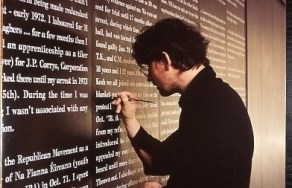
    IMMA Image of Cullen's work
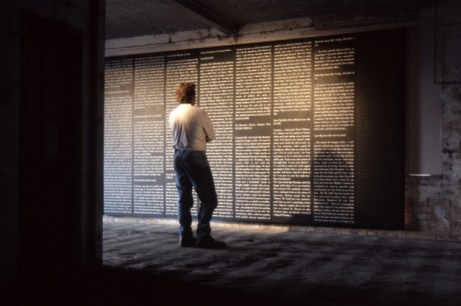
    IMMA Image of Cullen’s work

    It interests me when politicians, whether local or national, decide that they’d really like to censor the work of artists. This interest stems from my studies at UCD under Dr. Alistair Rowan, Dr Nancy Dunn-Czak, and of course Dr. Paula Murphy. The study of the History of Art includes numerous modules on censorship of art, including the censorship of art works here in Ireland from the foundation of the state onwards.


    Mostly I am interested in calls for censorship that derive from a political system that has existed in an unreformed state for many years, wherein politicians achieve power through local agitation, or as we refer to it here gombeen politics. Power in Ireland is sought after and attained when a (mostly) young male climbs from his youth group, to council, to government. A degree or equivalent isn’t really necessary to the hot housing of politicians, and therein lies the difficulty.

    Maybe I expect that local  politicians should have an awareness of the major policy issues of their party in government and if there is a lack in their understanding, then surely they could take advice? Advice on art censorship can be had simply enough by a call to one or other of our university art or historical departments.

    Shane Cullen’s Fragmens sur les Institutions Républicianes IV has caused some controversy in Athlone, where Cllr Mark Cooney has tabled a motion to have the work withdrawn from the Luan Gallery. Cllr. Cooney is a local politician of the Fine Gael party who are in coalition government with the Labour Party. Fine Gael has presented our Arts Department with our current Minister for Arts, Jimmy Deenihan T.D, who has made numerous pronouncements on the independence of both the arts and the boards of cultural institutes. Most recently in relation to unpopular merge proposals for our National Cultural institutes. 

    I read the (arts) manifestos, such as they were, of all the political parties coming up to the 2011 elections. They were not very inspiring and seem to present a seamless continuation of the previous government’s policies, that is, cuts to and bureaucratization of the arts. Nowhere was it mentioned that the then opposition parties would repeal the 2003 Arts Act which has had such profound effect on the independence of the arts in Ireland. Apart from slinging finances at The Gathering and the 2016 Commemorations, there are no new ideas. The Arts have always been second cousin to sports here, or maybe to a twee sentimentalism that represents how our country wishes to be seen abroad.

    A small local row about censorship has done enough for me to be convinced that a Cllr. of the FG Party calling for censorship of visual art has absolutely nothing new to bring to the table with regard to how he perceives the attainment and the usage of his power. I am waiting to be convinced that it is otherwise, but the Minister of Arts is conspicuously silent on the issue and the problem of censorship is hived off into local rows that speak of ignorance in responsibility to culture, heritage and arts in Ireland.
    •  A 2011 call for censorship of the arts (Cork, 2011)
    • Description of the work here
    • Locus+ archives

    Locus+ Image


  • ‘World Put to Rights’ by Kelly Creighton

    January 5th, 2013

    World Put to Rights

    The dream that burst riverbanks
    held you; blackstrap molasses,
    antidote for your poison.

    Your plummets spraying wetness
    like a coin in a cascade
    woke no-one, not even us.

    The church spire grew legs, scaled bricks,
    ran to your side, spotlighted.
    I put glass over that glow.

    Quiet-huff of your refuge,
    flailing arms, spluttering snores.
    Ungainly crooning tunes

    to the realms of purity;
    I found too sickly-sweet. You
    fought the humdrum, from your seat.

    You would sleep outside, would sing,
    stand on ledges mollified.
    I won’t sing, no matter what.

    Float on, keep your whistles of
    booze-hounds. When I awaken
    I will join you, watch for me.

    World Put to Rights is © Kelly Creighton , all rights reserved.

    .
    You can read more about Kelly at the following
    link. 


    Kelly Creighton/ Ceallach O Criochain is an Irish artist, writer of fiction and poetry; born in Belfast in 1979 she writes about contemporary relationships and local landscapes. Kelly has previously published poems and short stories in anthologies and magazines.Currently her poetry is in literary ezines including A New Ulster, Lapwing Publications. Recently her work was feature of the week in Electric Windmill Press.Kelly is editing her novel Yielding Fruit, a historical fiction set in West Yorkshire, she is also compiling her first collection of poems.

    • Index of Women Poets
    • http://issuu.com/amosgreig/docs/anu_issue_4
    • http://electricwindmillpress.com/
  • 2013 by Aine MacAodha

    January 1st, 2013
    “The Chinese New Year 2013
    marks the year of the Snake
    graceful and dark at the same time.
    As one year bows out to another
    I often reflect on past occurrences
    failures and wins, silly mistakes,
    see if I have learned from them.
    Death brought many clouds of grief
    at losing my brother so suddenly
    family gatherings feel strained
    we all want to talk about him but don’t
    for fear it will create even more sadness.
    Like a lost bead on a necklace, the space
    a constant reminder of his passing.
    Death is a leveler of sorts a stopper of tracks
    just like the new year as it approaches
    vows will be made and broken
    there will be make-ups and break-ups.
    Haves and have-nots, peace and war.
    With my anthology of wishes I push on.
    I wish 2013 be the year man returns to listening
    to his intuition like the ancestors did
    working from within using inner radar
    learn to be more spiritually aware of others.
    Respect the songs of others like the birds in the sky
    their choruses are many and they live freely.
    Slow down and awaken to the new.”.

    2013 is © Aine MacAodha

    Thanks to Aine for her poem 2013 to mark this New Year on Poethead. I am adding Aine’s website landing-page, Poetry and Links. Aine has published Fire of the Gaels on Poethead previously,  and I have included her in my Index of Women Poets.

    • Look out for Aine Mac Aodha and a bevy of contemporary poets at A New Ulster

    Aine MacAodha

  • ‘Tree-Wheel’ by C. Murray

    December 22nd, 2012

    Tree-Wheel

    In the rain its knuckled bark
    has the gloss of polish,

    a bottle-green patina.
    There isn’t a skull-head for pivot,
    tension is held in back of its palm
    it fists into the soil,

    raising it up.

    Beach

    Dragged impasto of seaweed
    aches against silver waves.

    I watch the wormholes
    ferry their glitter of sand
    in kaleidoscopes.

    Creative Commons License
    ‘Tree-Wheel ‘ and ‘Beach’ by C. Murray is licensed under a Creative Commons Attribution-NonCommercial-NoDerivs 3.0 Unported License.

    • First published at Bone Orchard Poetry as part of a sequence.
    • Image is ‘Willow trees’ by Pieter Wenning

    Willow_Trees_by_Pieter_Wenning.jpeg (1)
     

  • Where is the Arts Plan ?

    December 15th, 2012

    Letters by Colm Toibín and Hugh McFadden on Arts Policy in Ireland.

    The following letters published in the Irish Times re Arts Policy in Ireland.

    Where is the arts plan?

    “Sir, – At Listowel Writers Week on May 31st the Minister for Arts, Heritage and the Gaeltacht spoke about the importance of the policy of maintaining a system of one-remove between politicians and decisions about arts funding. It seems curious then that Culture Ireland, which was, as a result of a report commissioned and accepted by government, run as an independent body has now been brought into the Minister’s department from where it will be run directly. I think those of us who have worked with Culture Ireland have a right to ask on what basis this was done. Is there a document, for example, which shows how this move might save money or create efficiency? Is there a document which deals with possible problems in the future, should a minister, from whatever political persuasion, wish to decide what artists represent Ireland abroad and what artists should not?

    Since there are 113 national archives in the world and only two of them are merged with a national library, it might also be helpful to see a document which would show how money could be saved by such a merger here – the Canadian merger actually cost 15 million Canadian dollars – or how services would be improved, or how nothing would be damaged. The ethos behind a National Library – the making of books and manuscripts available to scholars – and the function of a National Archives – the preservation of documents emanating from government departments – seem quite distant from each other.

    As a novelist, I plan what I do. I would not dream of starting a novel without a blueprint, and I put a great deal of thought into that. Would it be too much to ask the Minister, or indeed his civil servants, to produce a document which would explain the reasons for merging some cultural institutions, abolishing boards, and bringing them and Culture Ireland directly under the Minister’s and the civil servants’ own control? – Yours, etc,”

    COLM TÓIBÍN


    Cancellation of the 2013 Éigse Michael Hartnett Poetry Prize

    Hugh Mc Fadden’s letter (15/12/2012)

    “Sir, – Not content with cutting funding for the health services, making life more difficult for the sick, the very young, the elderly, disabled, halt and lame, our benighted leaders are busily cutting funds for the arts.

    Grants to some publishers and magazine proprietors have been cut for 2013, thereby jeopardising the future of literary writing and the livelihoods of Irish writers.

    The latest news on the literary front is that Limerick County Council’s Arts Office has been forced by lack of funding to cancel the Michael Hartnett Poetry Award for next year, as they informed this correspondent this week. Who voted these governmental Philistines into office? – Yours, etc,”

    HUGH McFADDEN

     My response to weak arts policy in Ireland.

    I find the general response to the unconsidered and undebated continuation of previous governmental policies interesting. Arts in Ireland have moved toward a simple bureaucratised functionality based in the 2003 Arts Act. The mere fact that such letters are scant, confined to comment or letters pages, and not really looked at in terms of reportage indicates a lack of consideration for protecting and nurturing the arts and their fragile infrastructure.

    Response to inadequate arts policies reflect Irish intellectual response to such issues as blasphemy legislation, the destruction of Tara, and the run-down of critical institutions – a paucity. How utterly sad that short-termism and bureaucracy dominates Irish political (or supposed intellectual) thought.

  • 2012 Poets and Poetry Sites

    December 11th, 2012

    'Life or Theatre ?' Charlotte Salomon“

    I wanted to read or hear the narrative of someone else – a woman and a poet – who has gone here and been there. Who had lifted the kettle to a gas-stove. Who had set her skirt out over a chair, near to the clothes dryer, to have it without  creases for the morning. Who had made the life meet the work and had set it down.

    Eavan Boland , from Object Lessons. publ. Carcanet 1995.


    As ever, thanks to my readers who keep coming back to read, to make suggestions, and to send poems. My feeling is that overall 2012 has been a good year for women poets. There have been the usual scant begrudging reviews, there is still a visibility issue in terms of how many women are published, but poets like Alice Oswald, Ros Barber, Carol Ann Duffy, Eavan Boland, and all the women here published have most definitely placed the woman-poet in her room, on the street, and in the bookshop where young women and upcoming poets may find her if they care to look.
     

    I have added a list of blogs, journals, reviews and interesting sites to the end this post. I often link to my favourite blogs and sites directly in the posts. This year, I mention in particular Bone Orchard Poetry, CanCan, and WurminApfel. My perennial favourite websites are Jacket2, Guernica, The Harriet Blog (Poetry Foundation), Lemon Hound  and Poetry Ireland

    The easiest way to do this is to link the poets and translators published this year of 2012 as they were published. There is a handy monthly (2008-2012) archive to your right (and up the page a wee bit)

    2012 Poets; their poetry
    • Sarah Clancy, Hippy Get a Job and Phrasebooks Never Equip you for the Answers. (January 2012)
    • Glenda Cimino, I’ve Got the Fukushima Blues
    • Edith Sitwell, Green Geese (in Memory of Michael McMullin)
    • Brittany Hill , Nine
    • Rainbow Reed , The Storm
    • Kit Fryatt , Roxy and Nanna Slut’s Long Close Summer
    • Nuala Ní Dhomhnaill , The Mermaid in the Hospital and its Irish Original
    • Teresa Edmond, A Reflection on Blake
    • Dorothea Herbert, The Rights of Woman 
    • Elizabeth Bishop , Sestina
    • C. Murray, Chaplet
    • Aine Mac Aodha , Fire of the Gaels
    • Kate Dempsey , That Broken Pot
    • Louise Glück, Earthly Terror
    • Elisaveta Bagryana , The Bird with the Engine Heart
    • Eleanor Hull (trans) The Fairies’ Lullaby
    • Bloomsday, A Celebration of Irish Women Poets
    • Kit Fryatt ,  Untitled
    • Ruth Vanita , Effluence
    • Ileana  Mãlãncioiu , The Headless Bird
    • Antonella Zagaroli , Fan-Locked and Les Amoureux
    • Philo Ikonya and Helmuth A. Niederle ‘Pussy-Riot Forever; The Body’ , ‘Dictators Never ; Roll-Call’
    • Kimberly Campanello , We Protect the Weak
    • Nuala Ní Chonchúir , Die Schwangere,  Pregnant in Karlsruhe

    Journals, Blogs and Websites

    I had recommended some online poetry journals in my opening paragraph. and I thought to link them here. I am particularly fond of Bone-Orchard Poetry where I have (almost) published two sequences. Michael McAloran has an excellent list of working poets who he publishes on a rolling basis.

    Good Online Poetry Journals/Blogs
    • Bone Orchard Poetry
    • CanCan
    • And Other Poems
    • Jacket 2
    • Emerging Writer
    • WomenRuleWriter
    • WurminApfel
    • Bare Hands
    • SouthWord Literary Journal
    • Revival
    • Over The Edge
    • Crannóg
    • Burning Bush Revival (online)
    • Lemon Hound
    • The Harriet Blog
    • Poetry Ireland
    • Yes, But is it Poetry?
    • Dave Lordan Poet
    • Western Writers Centre
    • Gillian Prew
    Irish Poetry Imprints and Websites

    Those Irish Publishers, people involved in evolving tech to increase poetry readership, and poets who blog are listed in the sidebar of this blog. if I have neglected anyone, just contact me. I repeat the list here :

    • Éigse Michael Hartnett
    • Bone Orchard Poetry
    • CanCan
    • Cló Iar-Chonnachta
    • Crannóg Literary magazine
    • Dedalus Press
    • Gallery Press
    • Irish Pages
    • Kate Dempsey
    • Michael J Maguire
    • Nuala Ní Chonchúir
    • Partial Shade
    • Poetry Ireland Review Newsletter
    • Post
    • Revival Literary Journal
    • Salmon Press
    • The SouthWord Journal
    • The Burning Bush Revival Meeting
    • The Columba Press
    • The Dolmen Press
    • The Gallery Press
    • The Metre Archives
    • The Penny Dreadful
    • The SHOp , Poetry Magazine
    • The Stinging Fly
    • Wurm in Apfel
    The image is  ‘Life or Theatre’ by Charlotte Salomon
  • ‘In The Hug of Arms’; An anthology by Mariela Baeva

    December 11th, 2012

    Thanks to Mariela Baeva for her legacy project In The Hug Of Arms , an anthology of writing dedicated to the child victims of conflict. I am honoured to be a part of this work with a poem that was initially published in a group called Two Songs of War and a Lyric, by the SouthWord Journal at the Munster Literature Centre. The Poem Gernika was written to be read out at the 75th commemoration of the Guernica Massacre in 2012.


    About Angelita

    The image Mariela Baeva chose for her cover is  of a small girl from Anzio called Angelita who died from shrapnel wounds at the end of World War II. The contributors to the Anthology are from, Uganda, Somalia, Ireland, Russia, Belgium, Angola, the municipality of Anzio (Italy), Pakistan, Lebanon and Bulgaria. The texts are in English, French, Urdu, Somali, Russian (with translations into English).

    • There’s more information about the Anthology at this link.
    • PEN International newsletter is here , PEN

    5192018738_79d0cfff6e

  • “Die Schwangere” by Nuala Ní Chonchúir

    December 8th, 2012

    ‘Die Schwangere’

    ~ Pregnant in Karlsruhe ~

    The other poets drink damson schnapps
    from thistle-head glasses,

    My baby flicker-kicks
    with all five ounces of her weight,
    with all four inches of her length.

    I dream her hand
    pipping from the egg of my belly
    like a wing through shell,
    I hold her embryonic fingers,
    thrilling at her light touch.

    Delighting in my blooming belly,
    I feel my nestled passenger,
    she flicks and settles, settles and kicks;
    her cells gather, graceful as an origami swan
    in perfect folds and re-folds.

    In perfect folds and re-folds
    her cells gather, graceful as an origami swan
    she flicks and settles, settles and kicks;
    I feel my nestled passenger
    delighting in my blooming belly.

    Thrilling at her light touch
    I hold her embryonic fingers,
    like a wing through shell,
    pipping from the egg of my belly,
    I dream her hand.

    With all four inches of her length.
    with all five ounces of her weight,
    my baby flicker-kicks.

    From thistle-head glasses
    the other poets drink damson schnapps..

    Die Schwangere

    ~ pregnant in Karlsruhe ~ is © Nuala Ní Chonchúir.  The Juno Charm , 2011.

    .


    About the Juno Charm

    juno“In the tapestry that is The Juno Charm, award-winning writer Nuala Ní Chonchúir explores the worlds of two marriages – one waning, one waxing – and the pain of pregnancy loss and fertility struggles. This is an intimate book where the reader is taken by the emotional resonance of the poems, as much as by the exploration of the use of amulets and charms. The poems travels comfortably from County Galway – as in the wry Frida Kahlo Visits Ballinasloe – to Manhattan’s skyscrapers; and from the Seine in Paris to Dublin’s Liberty Hall. Ní Chonchúir once again employs her signature sensual frankness in poems of love and the body (‘I am the pomegranate / and you, the peacock // My seedy, red-pulped core / glistens with juice, / awaits your entrance’). Sometimes irreverent, always vivid, this is poetry ripe with imaginative possibility and wit. ” From Salmon Poetry

    Thanks to Nuala Ní Chonchúir for supporting Poethead with her poems and translations.
    • Her poems appear here and here on the blog.
    •  I also included Nuala Ni Chonchúir in a celebration of Irish Women’s writing on Bloomsday 2012.
    • WomenRuleWriter

  • “We Protect the Weak” by Kimberly Campanello

    December 1st, 2012
    We Protect the Weak

    We protect the weak and call it love or ethics.
    For the safety of our students this door
    must remain closed at all times. Ani yalda tova. I am a good girl,
    I tell the Israeli jeweler who is impressed with my Hebrew.
    Someone nearby says, Fuck Israel. I offer, I am a bad girl. Ani yalda ra.

     
    To dance is a kind of paralysis. Muscles contract
    in a certain way and we call it beautiful.
    The men on the beach made me think
    they were dancing tango, but instead one
    was helping the other will his feet to remember
     

    walking. If I had withered hands and always gave you
    your pen with my teeth would you think it beautiful?
    For the continued safety of our money
    these checkpoints must remain closed
    at all times. For the quality of our progeny these legs

     
    must remain closed at all times. These minds.
    This mouth. This heart. Why don’t you substitute
    your for these and this? See how it feels. Ani yalda ra.
    Feel that. Feel me feel you. Tell me I’m good
    and bad. Tova and Ra. Let us be both…
     

    © Kimberly Campanello

    Kimberly will be reading at the  National Concert Hall, on Thursday, December 6th 2012. Kimberly will be read her poems on the sheela-na-gigs in Strange Country, a new work by composer Benjamin Dwyer for uilleann pipes, tape, and poetry. More information and booking details can be found at www.nch.ie.

    We Protect the Weak was previously published in the pamphlet, Spinning Cities (Wurm Press, 2011). Kimberly read this poem at Catechism, Readings for Pussy Riot, in Dublin.

    .

    Kimberly Campanello was born in Elkhart, Indiana. She now lives in Dublin and London. She was the featured poet in the Summer 2010 issue of The Stinging Fly, and her pamphlet Spinning Cities was published by Wurm Press in 2011 . Her poems have appeared in magazines in the US, UK, and Ireland, including  nthposition , Burning Bush II, Abridged , and The Irish Left Review .

    Pic by Brian Kavanagh

  • The Metre Archives

    November 30th, 2012

    The Éigse Michael Hartnett  Facebook group linked to The Metre archives this week. Here are poetic treasures including essays, interviews, translations and reviews. The link that I just embedded above contains two Hartnett translations, Clocán Binn and Cén Áinius , introduced and discussed by Michael Smith. Metre was edited by Justin Quinn and David Wheatley.

    I decided to add the site onto my Irish Poetry Imprints blogroll so that my readers can do their own exploring rather than have me discuss the poems that I like. 

    Clocán Binn

    Calling bell

    Brought here by wild wind nightly
    I would contest your clarion
    Rather than war with women.

    Translated by Michael Hartnett

    I am linking my favourite download here with a recommendation to read the entire. The essay discusses a few preoccupations of mine with regards to dissipation of (unrenewable) poetic energies, performance, audience and response.

    O’ Driscoll quotes  George Mackay Brown who interests me, and  who is represented on this blog with his poem, The Masque of Bread.  I feel that George Mackay Brown is quite a neglected poetic voice, given the cragged and ruggedness of his expression, and  his use of symbol (especially in his use of light symbol).

    O’Driscoll brings Pliny’s letters into his discussion, and the art of Vona Groarke. I tend to subscribe to the Yeatsian adages about solitary writing myself, but it is interesting to look at an aspect of poetic writing which I feel intrigues many poets. Wallace Stevens had a horror of public-reading and is quoted here saying that he had no interest in being a troubadour and that he found public readings of poetry ghastly.

    I remember coming up against the reading or not reading issue in college whilst studying Julian of Norwich, who I believed to have written or dictated her works just for the inner ear, where the reader of the pages she offered could discern The Revelation of Love‘s musicality all by themselves. Needless to say my theory was met with a consternation (which I have not forgotten).

    I have linked the entire O’Driscoll essay here. 

    There is an under-developed Sound and Voice category on this blog which I have linked. I hope to add some new Kit Fryatt links there soon. I am also becoming fascinated with contemporary textual and sound poetry as a result of finishing the Modern and Contemporary Poetry at Pennsylvania course which I detailed in my Open Salon Blog.

    About Metre

    Metre was a magazine of poetry that ran for seventeen issues from 1995 to 2005. For most of that period it was edited by Justin Quinn and David Wheatley. It presented original poetry, reviews, interviews and essays. Published and printed in Ireland, edited by two Irish people, it nonetheless billed itself as ‘A Magazine of International Poetry‘: the desire was present from the outset to provide a platform for the best of Irish work alongside the best from the UK, US, Australia as well as work in translation.

    The magazine could not have continued without the generous support of the Arts Council of Ireland/An Chomhairle Ealaíon, and occasional support from the Arts Council of Northern Ireland. Also, patrons and sponsors generously contributed to our costs from the outset.

    This site presents a database of PDFs of original contributions to the magazine, and is hosted by the Faculty of Arts, Charles University Prague, under the auspices of the Centre for Irish Studies.

←Previous Page
1 … 55 56 57 58 59 … 106
Next Page→
 

Loading Comments...
 

    • Subscribe Subscribed
      • Chris Murray
      • Already have a WordPress.com account? Log in now.
      • Chris Murray
      • Subscribe Subscribed
      • Sign up
      • Log in
      • Report this content
      • View site in Reader
      • Manage subscriptions
      • Collapse this bar