Savings of €76 million need to be made by 2014 : NCFA Response to the NRP 24/11/2010.
The NCFA has issued a very restrained response to the proposed Governmental cuts in Arts andHeritage (Including Cultural Institutions), So it’s linked here, whilst I examine the faulty RSS feed:
These are being frontloaded in 2011 with a cut of €26 million. Final figures will be announced on Budget Day.€50 million will be saved over the remaining 3 years.
Only €5 million of this €26 million will come from a reduction in allocations to cultural institutions and cultural projects. See below:
* Reduced allocations to cultural institutions and cultural projects €5 million
* Reduced funding for sporting bodies and agencies including Irish Sports Council and National Sports Campus €3 million
* Reduction in tourism expenditure through operational efficiencies, prioritisation of activities and more focused tourism marketing investment €5 million
We checked with the Department today and we understand that the €5 million cut to culture covers Budget Lines D1-D10 in the annual budget . In other words €5 million has to be saved from across the following budget lines. How much each will be reduced by will be announced on Budget Day on Dec 7th.”
Slight Rant : Fianna Fáil Planning 2000-2010 and how it effects Ireland’s natural and built heritage.
Unfortunately , the issue here is of trust. The jaundiced and repellent Fianna Fáil approach to Arts, Heritageand Culture (including Gaelteacht Affairs) does not allow for green shoots, but presents instead a hackneyedand twee vision of Ireland. I do not think there will be a radical change in policy without a change in Government. Other Poethead Posts and Pages on this issue include petitions for Independent Writers Centresfunds not to be cut, the PH links to Save Tara and include the truly illiterate Blasphemy Criminalisation intoIrish law in January 2010. Even when the country was rolling in money , Fianna Fáil heritage policy involvedswapping actual Heritage centres for interpretative Centres, and under-funding the National Library archives tothe point of not providing them with heat, climate-control or decent storage spaces.
The Irish Green Party : ‘If you sup with the divil, best bring a long spoon made of Asbestos’.
Its pretty obvious that I have been opposed to Governmental policy in the Arts since the 2003 Arts Act,and since 2000 in relation to Fianna Fáil’s consistent negligence in heritage affairs, which have seen araft of planning bills introduced into the Dáil which have been not balanced with Bills that focus onConservation of Ireland’s natural and built Heritage. I suppose that when the EU , banks and planninginvestigations complete , the current Green party will hold up its hands and admit they didn’t know aboutwhat has been blindingly obvious to everyone else all along. The fact that we are and have been inBreach of EU Directive does not bother individuals or party members , because they have not beencriminalised and/or brutalised for pointing out years of abject failures or profit-centred planning, including the National Monuments Act 2004, The SIB 2006, The Housing (Miscellaneous Provisions) Act 2002which is delightfully known as the Trespass Law . In the period between 2000-2006 , Fianna Fáil did notpresent a single Act wholly focused on conservation, one can see where their priorities lie quite clearly and itmust be said those of their junior coalition partner too.
Whilst reading the Chris Agee edited Poetry (October – November 1995), I happened upon the truly beautiful Mother Ireland, penned by Eavan Boland. I am adding a Boston Globe interview (excerpted) and Eavan Boland link, entitled Exploring Poetry’s ‘Lesser Space‘ to the blog as this week’s Saturday Woman Poet , which is becoming a regular item on the blog. I have included the links to the Saturday Woman Poet archive and tag-set alongside other related links.
The interview is companion to a post that I re-blogged this week , entitled Female Complexities,Dorothy Molloy and fits neatly into the theme of intimacy in writing, as opposed to the monumental writ upon a large-scale canvas poetry beloved of politicians and other uncreative people. Sylvia Plath referred to this celebration of the small, the real and the domestic as a writing of the thinginess of things, the exploration of poetic voice grounded in objects. It is most visible in the final poem of her Ariel sequence, Wintering. I have linked both of these aforementioned posts on Plath and Molloy at the base of this post.
The Week In Irish Arts and Culture .
It has been an appalling and destructive week for Irish arts , this is grounded not alone in the economical situation but in what amounts to an ongoing policy or set of policies which have starved Irish arts at their root. A degradation of immense proportion has been occurring since at least 2004 , when the current Government initiated the National Monuments Act, which showed a scant attention to to the ideology of conservation, butrather favoured the ideology of destruction for profiteering. The swathe of heritage and cultural destruction reached its rational conclusion in three things , the bisection of the Gabhra Valley , the endowment of an Artist’s exemption to the ghost-written book of a former Taoiseach and the introduction of a Criminalisation for Blasphemy onto the Irish statute in January 2010, which has reduced our place in the press freedom league.
Exploring Poetry’s ‘Lesser Space’ , Boston Globe.
I do not believe that a Government should underestimate the alienation that occurs as a result of cultural self-vandalisation and ignorance of its role in stewardship and protection, but it apparently does , as it celebrates its own myopia and abject failure in the teeth of Ireland’s depression. From Exploring Poetry’s ‘Lesser Space’ (Boston Globe’s Interview with Eavan Boland).
“Explain how Irish women, as you write, went “from being the objects of the Irish poem to being its authors.“
AThe archetypical poem I have in mind is Yeats’s “Cathleen ni Houlihan,” which was a very romanticized, static portrait. The woman was so iconic and so overlaid with images of Ireland that for women to become the authors of the poem they had to somehow leave that object behind or contest it.
Q How did this affect you?
A It made me very aware of how difficult it was in Irish poetry to have an ordinary, day-to-day subject. Nineteenth-century painting, by contrast, often depicted the details of everyday life — people sitting in rooms, at tables; nobody questioned the value of those images to an artist. But when I was a young poet it was easier to have a political murder in the Irish poem than a baby.”
The Black Lace Fan my Mother Gave Me.
by Eavan Boland
It was the first gift he ever gave her, buying it for five five francs in the Galeries in pre-war Paris. It was stifling. A starless drought made the nights stormy…
They stayed in the city for the summer. The met in cafes. She was always early. He was late. That evening he was later. They wrapped the fan. He looked at his watch.
She looked down the Boulevard des Capucines. She ordered more coffee. She stood up. The streets were emptying. The heat was killing. She thought the distance smelled of rain and lightning.
These are wild roses, appliqued on silk by hand, darkly picked, stitched boldly, quickly. The rest is tortoiseshell and has the reticent clear patience of its element. It is a worn-out, underwater bullion and it keeps, even now, an inference of its violation. The lace is overcast as if the weather it opened for and offset had entered it.
The past is an empty cafe terrace. An airless dusk before thunder. A man running. And no way to know what happened then— none at all—unless ,of course, you improvise:
The blackbird on this first sultry morning, in summer, finding buds, worms, fruit, feels the heat. Suddenly she puts out her wing— the whole, full, flirtatious span of it.
I have decided to build up a set of links on Small Irish Publishers, this will evolve over time and I hope to add to it. The two that come immediately to mind and that I enjoy immensely are Cló Iar-Chonnachta and the Columba Press, both of which I am adding to the Links that run down the right side column at the base of this post. I have before now alluded to our wonderful book festivals and Culture Nights, these posts can be found peppered throughout the site and include The Dún Laoighre Mountains to Sea Festival, the Dublin Book Festival, the Forge at Gort, the Cúirt International Poetry Festival , Poetry Ireland‘s wonderful sponsorship of readings at the Unitarian Church in St Stephens Green and the countless library and literacy readings that occur under the aegis of the Independent Writers’ Centres and the Irish Arts Council. It is at these wonderful and immensely important places that art occurs and the small presses advertise and sell their wares.
The books on my shelves come from there or from friends who have found them for me in small shops all over the world. I have been reading this weekend Celia de Freine‘s FaoiChábaisti is Ríonacha and Cathal Ó Searchaigh’s An Bealach ‘Na Bhaile, both from theCló Iar-Chonnachta Imprint. The work that such presses do in disemminating Irish Literary Work is wholly invaluable and we should support it as much as possible. The Celia de Fréine book was bought at the Dublin City Hall Book festival in 2010, I got Tatú (Arlen) there in 2009, and the Ó Searchaigh was purchased in Indreabhán in 1996 (possibly whilst staying near Spiddal for the Annual Cúirt Festival in Galway that year).
I am adding their website link here and below in the links section, the following poem is Dídean le Cathal Ó Searchaigh :
Dídean , le Cathal Ó Searchaigh.
“Tá stóirm air” , a deir tú. ” Stoirm mhillteanach.” Míshociar, coinníonn tú ag súil an úrláir , síos agus aníos go truacanta, do shúile impíoch. Lasmuigh tá an oíche ag séideadh is ag siabadh timpeall an tí, ag cleatráil ag na fuinneoga, ag béicéil is ag bagairt trí pholl na heochrach. “Dheanfadh sé áit a bhearnú le theacht isteach,” a deir tú , ag daingniu an dorais le chaothair uilline. Tagann roisteacha fearthainne ag cnagadh an fuinneoige . De sceit, sciorann dallóg na cistine in airde. Creathnaithe, preabann tú as do sheasamh isteach i m’ucht, ag cuartú dídne. Ag breith barróige ort, téann mo lamha i ngreim i do chneas, ag teannadh is ag teannadh. Teas is teas, scarann do bheola ag súil le póga díreach is an stoirm ag teacht tríom ina séideoga. Splancaim is buaileann chaor thineadh do chneas .
On this site readers will find links to The Western Writers and the National Campaign for the ArtsRSS, please feel free to connect to the sites and petitions, which discuss short-termism in cultural advocacy by the Irish Government in supporting the root of Irish Arts: those that support and nurture writers in the Irish regions:
“The Arts Council of the Irish Republic has withdrawn its funding grant to the Western Writers’ Centre, Galway. The Centre also runs the annual ‘The Forge at Gort Festival’ in Gort, Co. Galway and the literary news-letter, ‘The Word Tree.’ For almost seven years it has been the only such centre West of the Shannon. We are calling upon writers and those with an interest in writing to sign this petition to have the Arts Council restore our grant.” (cf, attached Petition Link for Western Writers)
These two poems, Corcracht and Iniata, by Nuala Ní Chonchúir are translated by the poet.
Corcracht i gcuimhne Nessa
Céard tá ann nuair nach bhfuil tú ann ach:
scáthaghaidh na bhfoirgneamh faoi spéir fhuar na maidine, camsholas ar cheann slinne ag clúdach easnacha an tí, d’fhéitheacha teann faoi chraiceann do lámh, an chraobh liathchorcra ag tarraingt mí-ádh sa teach isteach, tobar dúigh as a dtagann línte doimhne, dothuigthe, coinneal na hAidbhinte ag comhaireamh i dtreo na Nollag.
Céard tá ann ach dath ár gcaointe duitse?
Purpling
Translated by Nuala Ní Chonchúir
What is there now that you’re gone, but:
shadow-fronted buildings under a cold morning sky, the memory of veins tightening under your skin, twilight on grey-wet slates covering the roof-ribs, lilac branches that bring bad luck through the door, an ink-well, dark with unintelligible lines, the Advent candle counting down to Christmas.
What is there, but the colour of our mourning for you?
Iniata
Iniata leis an gcraiceann seo tá
meabhair atá meadhránach le himní
anam atá chomh neamhshaolta, dothuigthe le ceo
croí atá féinbhriste, brúite mar úll.
Má tá sé ar intinn agat é a oscailt
bí ullamh: doirtfear fuil.
Enclosed
trans, by Nuala Ni Chonchúir
Within this skin please find enclosed:
a mind over-giddy with endless worry
a soul wispish as mist alien to its owner
a heart self-broken and bruised like fruit.
If you intend to open it
be prepared: it will bleed.
from Tattoo (Tatú ), le Nuala Ní Chonchúir. Publ.Arlen House 2007.
With thanks to Nuala Ní Chonchúir for the poems and translations from Tatú. Nuala’s new novel, You is available now. I have added a biographical link, so that readers may look up her books and enjoy her writing. The image which accompanies this post is courtesy of Kristina Mc Elroy, and is from the estate of her Late father, Artist Paddy Mc Elroy. I am adding some links here , to Nuala’s site, to my Cúirt 2010 visit, and to You (Via Amazon).
The first edition of Ariel was published by Faber and Faber in 1965. I am not going to trawl the pit of controversy over the Hughes selection, it has been done. The arguments and counter-arguments are known to mostly all lovers of Plath‘s writing. I will point the general reader to Hughes’ opening salvo in his introduction to The Collected Plath, hisWinter Pollenset of essays and to the foreword to the first edition of Ariel for that information.
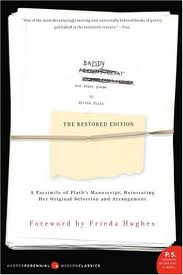
The Restored Edition Ariel was published in 2004, with a foreword discussion by Frieda Hughes. The full title of the edition is, The Restored Edition, Ariel. A Facsimile of Plath’s Manuscript,Reinstating her Original Selection and Arrangement . You can read Frieda Hughes’ forewordhere.
This means that the Ariel MSS that Sylvia Plath had left containing its interleaved and codependent set of themes has been restored to its original music in 2004 (39 years after the Hughes edited publication). I feel that it should be the only collection of “Ariel” available, as it is uniquely Plath’s.
The above may be difficult for someone who is not a writer of poetry to understand, but ironically enough it was Hughes who perfectly described Plath’s approach to her making of the poem as hermetically sealed. It hid from her and she worked incredibly hard with many false starts to unearth the work. That was not the case with “Ariel”, which came absurdly quickly.
A book of poetry is not necessarily themed but unified in the interrelationship of the poems, the book’s internal music and the alchemy of words therein. Sometimes a poem is related intimately to another through a strange labyrinthine undercurrent of word and energy which may not be visible to the critic or academic.
As Frieda Hughes points out in her foreword, the two words love and spring form the first and last word of The Restored Edition, in the poems, Morning Song and Wintering. This symbolises the internal music of Sylvia Plath’s volume and indeed the interrelationship of every internal sound, chosen word and interleaved theme. It is restored because the binder was retained , treasured and read by the family and her children.
39 years might be a time to wait for that restoration of music to its meaning, but interestingly it was always preserved intact, which readers of literature are aware does not always happen historically with words that enlighten, provoke orhurt..
from Morning Song, by Sylvia Plath.
(first verse)
‘ Love set you going like a fat gold watch. The midwife slapped your footsoles, and your bald cry Took its place among the elements.‘
from Wintering , by Sylvia Plath.
(last verse)
‘Will the hive survive, will the gladiolas Succeed in banking their fires To enter another year? What will they taste of, the Christmas roses? The bees are flying, they taste the spring.’
EDIT : I am adding in here as the final link a YouTube of Sylvia Plath reading Daddy
In 2009 the Archives of Cologne collapsed , Speigel English reported it as ‘History in Ruins, Archive Collapse Disaster for Historians‘. It always interests me as a sometime collector of letters, books and such ephemera that Governments often do not prioritise our history in a manner that will benefit future students of culture and politics.
Yesterday morning there were reports of an ongoing dispute between French Archivists and the Government of Nicholas Sarkozy , or rather , more specifically Nicholas Sarkozy’s Legacy Museum Project, which is centred in the National Archives in Paris :
” It’s one of the grandest palaces in central Paris, housing treasured national documents from Napoleon’s will to the rules of tennis. But behind a makeshift barricade of box-files and banners, staff are camping out in sleeping bags, as France’s National Archives become the frontline in the biggest cultural revolt of Nicolas Sarkozy‘s leadership.
Historians are rising up against the president’s grandiose plans to immortalise himself by founding a national history museum in his own image. Just as François Mitterrand built the Louvre pyramid and Georges Pompidou lent his name to the landmark modern art museum, Sarkozy is searching for his own cultural legacy. But his planned museum, with its emphasis on “national identity”, has been attacked by academics as a dangerous, nationalistic attempt to pervert history for his own ideological purposes.”
(Guardian report 10/11/2010)
The questions really have to be grounded in how Governments see their role in preserving the past ?
(i). Do they protect the buildings which house archives from problems such as runaway development and gentrification ?
(ii). Are there adequate disaster management plans in place that are planned and strategised at governmental /departmental levels ?
(iii). Is Governmental funding for the provision of adequate storage and climate-control infrastructure a priority in terms of paper/data archival storage ?
In terms of good news today , UCD celebrates the launch of the Irish Virtual Research Library and Archive ( IVRLA ). I am adding in a paragraph about the launch and a link to the Press release:
” The Irish Virtual Research Library and Archive (IVRLA) digital repository draws on UCD’s extensive archival resources, allowing this material to be accessed in a digitised format from a single virtual location. The IVRLA presents 32 curated collections as well as a series of 17 research projects which demonstrate the research potential of this major digital repository.”
( from Library.ie)
There are ongoing problems with our National Library storage , including its dependence on Dáil Éireann for heat, but its good to see that resources and archive services are provided for in UCD. Visits by staff from the British library and skill-sharing in disaster-management form part of the NL’s policy here. I hope to update on the Archives of Cologne, the French National Archives dispute and digitizing Archival resources in a later post and will link further in the comments section.
A Renaissance for Literary Magazines, from the Guardian: adding a Guardian Books RSS Feed.
Note : I have added an RSS feed link to Guardian Books into the central column beneath this post, there is a very interesting report therein on how Tech advances a Literary Magazine Renaissance, which should be of interest to publishers, writers and readers. I am linking it here.
from ,Paris Review (RSS Link on Poethead main page)
“Michel Houellebecq has finally received the Prix Goncourt, France’s most prestigious literary prize. As Susannah Hunnewell suggested in our current issue, the honor is overdue. Clickhere to read the most in-depth interview with Houellebecq available in English.
As our diarist Nelly Kaprielian reported last September in The Paris Review Daily, Houellebecq is still living hard. He has aged visibly in the last couple of years. He even tells her that his latest novel, La carte et le territoire, may be his last. We hope and trust that time will prove him wrong.”
There is a permanent RSS link to Paris Review on the main page of the Poethead Blog, which readers can find beneath this post also. The above quote forms the opening two paragraphs to the announcement that Michel Houellebecq has won the 2010 Prix Goncourt for ‘ La Carte et le Territoire’ . Paris Review is today running an interview in English with Houellebecq . Recommended reads by Houellebecq (by me) include HP Lovecraft , Against the World, Against Life and Atomised. I have included links to both here,
How eerie it all is, as if linked by synapses; a face stutters out of the cloud of lace, a tiny decorative lion dances in a frieze, a woman, needy arms outstretched, holds on
to thread bulwarks against some unseen flood while her body dissolves into netting, the knots widen and widen until the limn of her is finished, she melted to loops of distance … and isn’t
that how you’ve transformed, once-love, while this strait sleeping-car, this time spirits me away from you and that night we lay two palms folded to each other in prayer:
how the cat yowled to be let in! and the moths, darting abortively forward, all ended up by clinging to the screen in the sleep-sacs of their wings, while I rolled to the top of my tongue
that word which would end everything and like Sisyphus, let it fall.
Nothing brings that second back, yet nothing gets lost;
hours that separate me from you only tighten the memory-chain, where my thoughts like these light acrobats trapeze; in the white spiderwebbing, in the network
here’s a sea serpent, a helmeted soldier, a boy pausing to sing, two dogs leaving a fountain, someone pushing aside a harp. The tiny o of her mouth. Those gouged-out holes, her eyes.



 Chris Murray