The Icelanders have a word that means just that. A murky day that you know is better enjoyed from the comfort of a window seat; soft mizzle cleansing leaves shiny and bright.
When webs become crystal dreamcatchers, or perfect drops form on the telephone lines and slide slowly down like the oil on the wire of the indoor rain lamp,
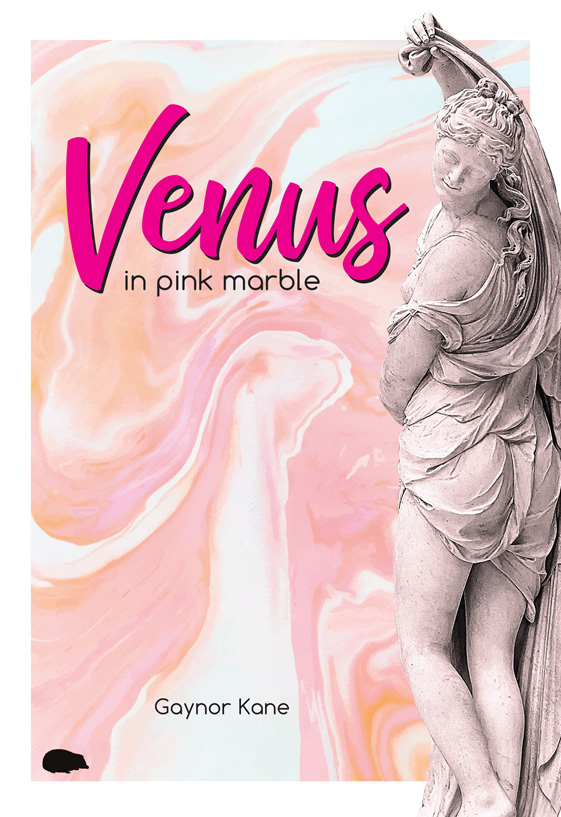
with Venus in pink marble, her flowing robe revealing perfect curves against the plastic plants. Outside the blackbird puffs himself,
feathers rippling. He dances on the lawn. Drizzle doesnât bring the worms up but his fancy seven step has the desired effect and he pecks and pecks and pecks;
like the drinking woodpecker did, long ago, on the dentistâs counter, see-sawing, a globe of red liquid dancing, as I looked passed it and through the window,
longing to be outside in the rain.
Â
Spring Bank Holiday
We travelled far from city noise to wide skies, woods, wetland and a lapping lough-shore. Lego birds had been the bribe.
Leaving Minecraft in the boot we time-travelled, from plastic blocks to the kiln, where men had fired clay bricks. Further back, in the Crannogâs rustic roundhouse, we stroked hand-daubed clay walls.
Posed for pictures with brick birds but spent more time feeding the living, adding new naming words, researching migration paths, becoming birders. Pinched your mouth on finding a yolk-stained shell outside the coop.
Drifting off homeward bound with Shovelers, Shelducks, Redshanks flying around your head, Best day out, EVER, you said.
Until the next oneâŚ
Â
Dreamchild
These Strangford wetlands and fields, inlets, islets and islands, one for each day of the year, are your haven; curlew’s perfect landscape of mottled wheat and barley camouflage, speckled pointed eggs.
Quaver call carried on the breeze floats through open sash as I drift off to dreamland. Ash thin, plane-grey legs vapour-trailing a cloudless sky over a moonlit low-tide lough,
transforming into my daughter. Feathers curl into auburn hair, down-curved beak becomes a bow poised to shoot fox mid-flight. Quiver strapped breast. She soars towards Scrabo Tower.
Dreamchild returns to loughshore. Wades at waterâs edge, where along Monaghan bank, Iâm walking with a thatched batch of uni stats. She does not speak, roots under rocks shyly searching for shellfish.
Six Curlews arrive to join her. She shrinks, cane legs and crescent beak reform, feathers return as she outstretches both wings. Seven whistlers take flight. Please â please come home.
Window weather and other poems Š Gaynor Kane
Gaynor Kane lives in Belfast, Northern Ireland. She came to writing late in life, after finishing her Open University BA(Hons) degree with a creative writing module in 2015. Mainly a writer of poetry, she has had work published in journals and anthologies in the UK, Ireland, and America. In 2018, Hedgehog Poetry Press launched their Stickleback series with her micro-collection Circling the Sun, which is about some of the early women pilots. Gaynor has just released her chapbook Memory Forest, also from Hedgehog Press. That is a thematically tight collection about burial rituals and last wishes. She is currently putting the finishing touches to her debut full collection, after receiving an Arts Council NI grant in 2019, which allowed her writing time and mentoring and editing services.Gaynor is a member of Holywood Writersâ Group, The Irish Writers Centre, and Women Aloud NI. She also volunteers for EastSide Arts during their summer festival and the CS Lewis Festival in November. Gaynor is a keen amateur photographer and has had some of her photography published in journals and anthologies.
This is an excerpt from a reflection on Gold Friend published online in the Irish Times (16/09/2020). Thanks very much to Martin Doyle who offered me the space to write about the book and about Poethead.
…The convergence of influence and imagery that is inherent in Gold Friend began at Drimnagh Castle and works from there into other places and into other books too. The gold friend is both a literary device and an absent person who acts as a passive receptor of knowledge. The gold friend is disembodied, and cannot access the sensory world, or experience it as we do,
Periphery
Be near enough to the periphery to discern the wing-settle-sounds small birds make in thickets, Â Â Â Â Â Â Â Â Â Â Â Â Â Â Â Â Â Â their halls – Near enough for red to insist that you regard it as haw, Â Â Â Â Â Â Â Â Â Â Â Â Â Â Â rose-leavings Know, bird-panic sounds differently to wing-settleâs soft-rest after the flurry of flight, Â Â Â Â Â Â Â Â Â Â Â Â Â Â â they say
All the books that a poet writes are interconnected in some way. Gold Friend is connected very much to bind. It comes very soon after the publication of bind because many of the poems were written at the same time as that book. Bind had a thematic thrust that rejected some of the more light-filled poems that inhabit Gold Friend, but they share certain commonalities like the prevalence of the non-human world, the use of a very limited colour palette, and the simple joy of just being in or of this increasingly complex world. Shared themes include necessity, the necessity for description, the non-human, and mythos.
You can read more from the reflection here. I have added a link to the launch video below this brief post.
This film includes a sound adaption of ‘Nocturne for Voices One and Two” by Una Lee, a talk by Salma Ahmad Caller about the art for ‘Gold Friend’ and ‘A Hierarchy of Halls’, and the art that you can see on this site every time you click in. The piece is called ‘Making Den of Sibyl Wren‘ (Salma Ahmad Caller, 2018). Thanks to Lucy Collins who asked the questions, read, and talked about the book. I did some brief readings and talked about the book too. The whole thing was designed, edited, and created by Liz McSkeane, my publisher at Turas Press.Â
Order ‘Gold Friend’ here if you’d like, but please do watch and enjoy the film which replaced a traditional launch and was filmed in Dublin, Reading, and Belfast over the last two weeks.
Image: Salma Ahmad Caller reading beside the artwork ‘Making Den of Sibyl Wren‘. (2018) You can see some of the details from the piece at this link.
“Gold Friend” a second Turas Press collection from Chris Murray. This book is currently available for pre-order. The publication date is September 9th, 2020. Image Š Anna Murray
Â
Gold Friend was launched on September the 8th 2020.
This film includes a sound adaption of ‘Nocturne for Voices One and Two” by Una Lee, a talk by Salma Ahmad Caller about the art for ‘Gold Friend’ and ‘A Hierarchy of Halls’, and the art that you can see on this site every time you click in. The piece is called ‘Making Den of Sibyl Wren‘ (Salma Ahmad Caller, 2018). Thanks to Lucy Collins who asked the questions, read, and talked about the book. I did some brief readings and talked about the book too. The whole thing was designed, edited, and created by Liz McSkeane, my publisher at Turas Press.Â
Order ‘Gold Friend’ here if you’d like, but please do watch and enjoy the film which replaced a traditional launch and was filmed in Dublin, Reading, and Belfast over the last two weeks.
Image: Salma Ahmad Caller reading beside the artwork ‘Making Den of Sibyl Wren‘. (2018) You can see some of the details from the piece at this link.
07/09/2020 Elegy and Displacement in ‘Gold Friend’ – at Writing.ie
The title of my book is Gold Friend. The phrase or image associated with it is derived from an Anglo-Saxon poem The Wanderer which is rooted in elegy and in personal displacement. These are the themes of the book, which I will allude to a bit later on in this short essay.
Gold Friend began, as my books do, from a collection of small themed notebooks. In this case, it originally comprised five small books that were loosely thematically related according to how I compose or create the poem image
An independent, Dublin-based publisher dedicated to providing a platform for new and innovative writing. In Irish and Scottish Gaelic, âturasâ means âjourney.â Turas Presswas founded in May 2017 to support writers of poetry and fiction in launching their work into the world and finding an audience.
On Gold Friend by Chris Murray
Our latest news is that Turas Press is preparing for the publication of our 2020 list. Although the physical launches of our new books wonât take place until some time in 2021 â depending on how the management of COVID 19 evolves â we will continue to publish our books and make them available online and through participating booksellers.
A new collection from Chris Murray, âGold Friendâ will be published in the autumn of 2020. This is Chrisâs second collection with Turas Press â her readers will recall her beautiful âwaking bookâ bind which came out in 2018.
Gold Friend Acknowledgments
Chris Murray wishes to thank Billy Mills, Amy Wyatt Rafferty, MĂźesser Yeniay, Lucy Collins, Eithne Hand, Richard Krawiec, Peter OâNeill, Una Lee, and Soodabeh Saeidnia editor of âPersian Sugar in English Tea’. Poems from this book have been published in The Bangor Literary Journal, Levure Litteraire, HiRISE (NASA), One (Jacar Press),Persian Sugar in English Tea, Ĺiirden, and The Poetry Bus Magazine. A Version of Lament for a Lost Child was originally performed at the Beal Festival of New Music and Literature at the Smock Alley Theatre, with thanks to Elizabeth Hilliard and David Bremner. Nocturne For Voices One and Two was adapted by Una Lee for spoken word project Songs to stay awake to to be released in 2020.
Cover Art by Salma Ahmad Caller
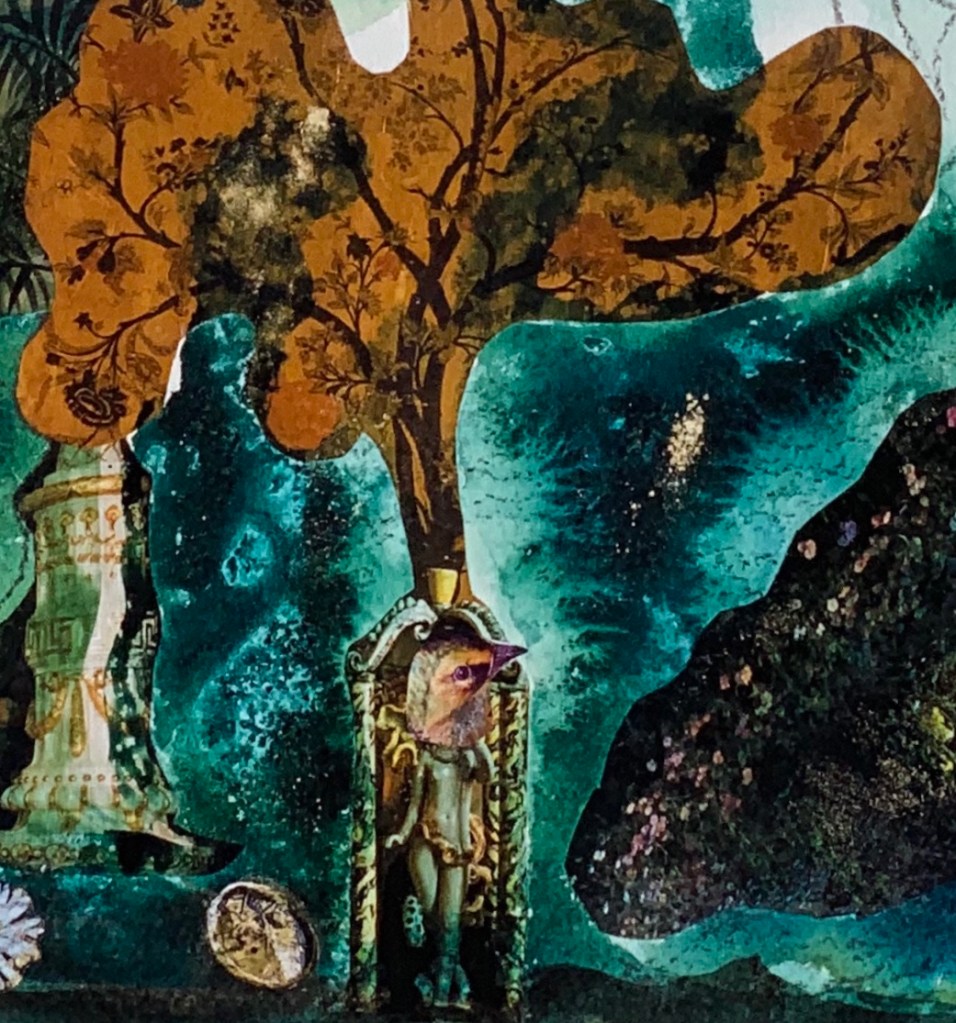
The cover art for Gold Friend is a detail from ‘Making Den Of Sibyl Wren‘ (2018) by artist Salma Ahmad Caller.
Materials: Watercolour, Indian ink, collage, graphite, and gold pigment on Fabriano acid-free paper 57cm x 76.3cm. An essay on the making of the artwork is available here.
Salma Ahmad Caller is an artist and a hybrid of cultures and faiths. She is drawn to hybrid and ornamental forms, and to how the body expresses itself in the mind to create an embodied âimageâ. UK based, she was born in Iraq to an Egyptian father and a British mother and grew up in Nigeria and Saudi Arabia. With a background in art history and theory, medicine and pharmacology, and several years teaching cross-cultural ways of seeing via non-Western artefacts at Pitt Rivers Museum in Oxford, she now works as an independent artist and teacher.
Lucy Collins is Associate Professor of English at University College Dublin. Books include Poetry by Women in Ireland: A Critical Anthology 1870â1970 (2012) and a monograph, Contemporary Irish Women Poets: Memory and Estrangement (2015), both from Liverpool University Press. She has published widely on contemporary poets from Ireland, Britain, and America, and is co-founder of the Irish Poetry Reading Archive, a national digital repository.
Lucy Collins on “Gold Friend”
“At a time when we are grappling with multiple, related challenges â living with climate change and pandemic â these poems remind us to celebrate and care for, the natural world. Lucy Collins says this of âGold Friend”. âAs well as bearing witness to the strange beauty of the natural world, these innovative poems testify to the remarkable intensity of human perception. They deserve our closest attention.â