Redeeming Faith |
|
|
Redeeming Faith |
|
|
  |
The weft of Margaret Atwood‘s The Penelopiad is contained in and revealed through the chorus voiced by the twelve maids hung by Telemachus (on Odysseus’ orders) just after the men returned from their manly adventures. Margaret Atwood runs the chorus line throughout her Penelopiad, the executed maids sing their songs at ten intervals in the book. I was struck by a comment that Atwood makes in her notes about the maids. She stated that:
‘The Chorus of Maids is a tribute to such uses of choruses in Greek Drama. The convention of burlesquing the main action was present in the satyr plays before the main drama.’ (Margaret Atwood, Author Notes for The Penelopiad pp. 197-198)
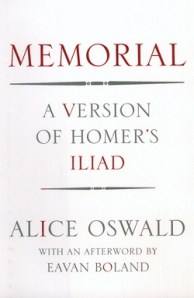
I am always interested in how women writers burlesque the heroic perception of the classics through use of device and structural underpinning. In this instance I have been reading Atwood’s The Penelopiad and Alice Oswald‘s Memorial. Both Atwood and Oswald approach Homeric themes in a sidelong fashion to get to the meat of the oral tradition, their poetic focus is decidedly on the lament. Atwood gives voice to the subversive and unquiet maids of The Odyssey. Oswald creates a dirge through interweaving the names of fallen warriors of The Iliad. Both Atwood and Oswald use the lament as the kernel for their thematic variations from and approaches to Homeric mythos. The poets use repetition to add texture to their laments thereby shaping and focusing the small forgotten voice toward expressing a universal grief. This is a not heroic poetry, it is a poetry of keening and loss.
Oswald’s Memorial has drawn quite divided critique. I mention in particular Jason Guriel‘s reductionistic approach to the book in which he refers to it as ‘a rose-fingered yawn’. This slighting throwaway remark does little to evoke interest in how women poets actually write, nor does it sufficiently disguise Guriel’s critical ennui. I would point the general poetic-reader to Michael Lista’s critique of Memorial in order to garner a more balanced view of the work.
Atwood’s twelve maids defiantly do not not burlesque the main action of The Penelopiad. They are the main action of the book. Penelope reveals herself to be a tedious bore whose lack of wit and guile are vaguely repellent. I wanted Atwood to get her toe out of the water and focus on the maids who enliven the text with their songs and shanties. The central pivot of The Penelopiad revolves round the nasty relation between Penelope and Helen rather than on the texturing of the maids burlesquing. In this, Atwood’s approach to Homer is a bit of a missed opportunity. The strength of the book is in its sub-theme which Atwood had not developed into a fuller rendering.
Oswald did not make a similar mistake in her approach to Homer’s The Iliad. She has broken down the book and re-made it a powerful dirge. The fact that this has led to an inability by her critics to get to what she is doing only strengthens the work in my view. The index for Memorial comprises an unnumbered litany of names from The Iliad. Oswald weaves their names into the text whilst interspersing their histories with individual laments for the warrior-groupings. These laments vary in length, they are devices to allow the mourning voice through. They are not separate to the main action of the book but are organically interleaved into and caught up in the theme and direction of this epic poem-dirge.
| ‘Like a man put a wand of olive in the earth And watered it and that wand became a wave It became a whip a spine a crown it became a wind-dictionary It could speak in tongues It became a wobbling wagon-load of flowers And then a storm came spinning by And it became a broken tree uprooted It became a wood pile in a lonely field.Like a man put a wand of olive in the earth And watered it and that wand became a wave It became a whip a spine a crown it became a wind-dictionary It could speak in tongues It became a wobbling wagon-load of flowers And then a storm came spinning by And it became a broken tree uprooted It became a wood pile in a lonely field.’Page 31, Memorial, by Alice Oswald |
It interests me that contemporary women poets are approaching Homer through the use of the lament. They are voicing the silent mourning that occurs when the glory of battle is over. Atwood is giving voice to the abused girls whose life experiences are of enslavement and of misuse. Oswald does not state that the mourning voice in Memorial is that of a woman, but the cadence of the mourning poems that intersperse her text suggests the chorus, the lament.
In terms of contrast in poetic approaches to direct engagement with classical literature, one could point to how Ted Hughes re-told the twenty-four Tales From Ovid (Metamorphosis) or look at Heaney’s Beowulf. The fact that critique ignores the poetic engagement of women with the classics of literature only points to critical-disengagement, or at best to a narrow conservatism. It is time that The Chorus (that most pertinent part of Epic) is re-read, and given its place in the overall texturing of great poetic works. What would T.S Eliot’s Murder in the Cathedral be without the integrity of the women’s voices?
 |
| ‘…he took a cable which had seen service on a blue-bowed ship, made one end fast to a high column in the portico, and threw the other over the round-house, high-up, so that their feet would not touch the ground. As when the long-winged thrushes or doves get tangled in a snare…so the women’s heads were held fast in a row, with nooses round their necks, to bring them to the most pitiable end. For a little while their feet twitched, but not for very long.’ The Odyssey, Book 22 (470473) |

Transverse threads, women poets and Homer by C. Murray is licensed under a Creative Commons Attribution-NoDerivs 3.0 Unported License.
| press-to drop-by-drop raindrop-and-sinew the whole woman not tamp-in onto the still-living-soil a new shape embed-in the bone and the living-sinew-of the still-warm blood slowly-so and infinitely blue the milk-flow from crystallising breast a stone-dress .material as silk-soft caul or veil can be sweet as silk or rain or blue rain sinews against and into chalice of womb. half-into the wall and often not still a lone bird night-sings Fossil 1 is © C. Murray First published, A New Ulster issue VI , 2013 |
Poem for MalalaTo Malala Yousafzai. We see it all. The red-stain, We do not feel the skull-shatter-impact, the tubes. Your eye, Red filters down, Father – Mother Child child child child child. Somethings are veiled. to cover A green veil. the tip of I would sew the sequins myself, If you must veil, as laurels, green, on your head. |
|
.
|
Glossy women made her tremble,
every word shiny and sure,
we’re going to give Jenny a make-over,
Jen, the decaying building,
the clueless relic.
They made her sweat, even more,
those women with Dior skirts
and nipped-in waists, who warned
the night before the wedding
about being prepared.
But it was 1951. Next day,
she tried not to faint at the altar
although the neighbours whispered,
later forced herself to stuff
some morsel of the wedding breakfast
through her lips, like bad language
or something a woman never did
masticate, masticate, chew, chew, swallow,
the fist of the still-hidden child
walloping her gorge as the best man rose,
twinkle-eyed, yellow card in hand,
a twist of jokes she’d be bound to appreciate.
Marriage Advice, 1951 is © Mary O’Donnell
It has grown, not darkly, like mould, that sunless green. Sitting
provides the habit of air. Children – trees, coats, limbs,
the bounce of long hair as they troop the school road –
means stillness, expansion, despite unspeakable radio news
on the murder of infants in temperate suburbs. Muffled, gloved,
I grow in a car at the end of an eight-year planting, half of me
mulling the latest distant shooting. I would like to book a flight,
transplant skills, solutions, get there fast. Instead, I wait, the smell
of cooked dinner impregnating denims, boots, my cap, which she
inhales as she steps inside the car. I hold myself together
beneath iced winter branches in grey couteur, feel an invisible
frieze of buds stirring slowly, steady in deep cold.
.
Waiting is © Mary O’Donnell

Mary O’Donnell is the author of eleven books, both poetry and fiction, and has also co-edited a book of translations from the Galician. Her titles include the best-selling literary novel “The Light-Makers”, “Virgin and the Boy”, and “The Elysium Testament”, as well as poetry such as “The Place of Miracles”, “Unlegendary Heroes”, and her most recent critically acclaimed sixth collection “The Ark Builders” (Arc Publications UK, 2009). She has been a teacher and has worked intermittently in journalism, especially theatre criticism. Her essays on contemporary literary issues are widely published. She also presented and scripted three series of poetry programmes for the national broadcaster RTE Radio, including a successful series on poetry in translation during 2005 and 2006 called ‘Crossing the Lines‘. Today, she teaches creative writing in a part time capacity at NUI Maynooth, and has worked on the faculty of Carlow University Pittsburgh’s MFA programme in creative writing, as well as on the faculty of the University of Iowa’s summer writing programme at Trinity College Dublin.
|
|
The following two poems are by Sarah Clancy from a forthcoming collection of prose and poetry, called Friction.
Veracity and other stories Gullible. |
A New Ulster Poetry and Literary Ezine
|
What distinguishes A New Ulster as poetry journal is evident also in Bone Orchard Poetry and in other Ezines that are led by artists and writers who respond with alacrity to a need for publishing platforms for new and established writers. When I started this blog five years ago, I did a yearly review of what is offered to the poetic writer in the way of publishing platforms. The developing commitment of literary editors to the usage of online tools, such as Ezines, BlogZines, online-publication, and adapting traditional publication was at an exciting point. Jacket2, Harriet the Blog (The Poetry Foundation) and Poetry Ireland were busily adapting to and testing the poetic waters, as was UBUWEB . Editors have been using social-media tools to ensure that poetry is read. I find it strange that there appears to be an inherent distrust of the medium in some quarters here in Ireland. Underutilisation of open-source systems and social media tools strikes me as a little ungenerous.
The years began providing exciting new magazines and platforms, an increase in poetic-writing is showing itself in publications like Burning Bush 2, And Other Poems, Anon Publications, Bare Hands and Southword, to name a few. The other side of the coin is how traditional publications are adapting to internet and using social-media to advance poetic writers and their audiences. It may have been bold to claim a poetic-renaissance but I am sticking to it, maybe others will catch up when they get their heads out of Miley Cyrus’ arse, who knows ?
A New Ulster a publishing platform led by Amos Gideon Grieg and Arizahn, is that wonderful poetic-hybrid of traditional and internet publication that uses a wide variety of social-media platforms to generate audience and writer alike. Because the publication is writer led, the editors bring in their skills as poet and fiction-writer, and their (hopefully not exhausted enthusiasm) for new forms and methodologies of communicating literature with their readers.
Poets featuring in a New Ulster include :
 |
untitled image , oil on canvas by © Michael McAloran 2003
histology slice 3
[ a tissue cloth so delicately coloured in mauves and purples indigo
and ivory cells become tissue whereas this isn’t at all the case
all is one in febrile disequilibrium not excluding momentary states
of euphoria and relative equilibrium the macabre beauty of histology
like a travelogue along enlarged detailed drawings of funghal spores
or sporoform zoophytes white exquisitely and hypersensitively drawn
by haekcle against a black CSO corps sans organes the hubris debris
humus against which lines flightlines maps nomadologic trails micro
politic events pointillistic gestes rhizomatic ghanaean junglean infra
branchings dadaistic or ba’akan pygmee refrains establish unfold
glare and disappear amongst glacis’ of ice basalt slate sapphire or
northsea grayness and mist histology is that : the slice with obsolete
or ephemereal or contingent a truth to leave the observor with her’s
his’s own ponderings of carcinogenic intimacy or clean tissue missive
towards the ones receptive the ones donating slices out of their body
to be mapped navigated coloured in mauves grays deep purples
to indigo ]
Text is © Aad de Gids
Of strangeness that Wakes us by Ilya Kaminsky
Published Poetry Magazine, January 2013. A Publication of the Poetry Foundation
Todesfuge, by Paul Celan is a poem that I have mentioned here on Poethead in a variety of guises since I first read the poet Paul Celan in Fathomsuns’ and ‘Benighted’ (Carcanet, Trans. by Ian fairley)
Later, I went on to acquire the book, Paul Celan Poet, Survivor, Jew by John Felstiner which has a chapter entitled, ‘A Fugue After Auschwitz (1944-45 ) /your ashen hair Shulamith’, detailing Felstiner’s approach to the translation of Todesfuge. I blogged my reading of Todesfuge here .
In many ways I do not feel as if I will ever finish with the reading of that poem. I feel that this blog space is too limited to write about Paul Celan and his dedicated translators including, Ian Fairley, Pierre Joris, and John Felstiner. However, when an interesting article or translation of Celan emerges I link to it here. Poetry Magazine (January 2013) has an article on Celan’s poetry, including some discussion of Felstiner’s translation of Todesfuge. The text of the Felstiner translation of Todesfuge is included in Of strangeness that Wakes us by by Ilya Kaminsky.
Here Kaminsky discusses Celan’s alleged hermeticism , which the poet himself denied. He looks at the issues of expressing the experience of the Jewish poet Post-Holocaust and at Adorno’s exhortation that ‘it is barbaric to write poetry after the Holocaust’.
Poetry had to be written after the Holocaust, as art had to occur. Weil or Tuominen would describe poetry written in cataclysmic times as a poetry of necessity.
The expression of the WWII diaspora poet in the great Todesfuge becomes, in Felstiner’s words an encapsulation of or/ the Guernica of Post-War European Literature. Those readers of Celan who come to Poethead to link to Celan’s works will be intrigued by Kaminsky’s discussion on Celan’s poetic-process, his approach to language, to the creative-process, and to his expressing of human catastrophe
On Felstiner’s translation of Todesfuge Kaminsky says,
‘In my private library, this is one of the great translations of the twentieth century. But the word “translation” to my mind is misleading. This translation (or any great translation, for that matter) is not a mirror. While one appreciates Felstiner’s haunting use of German words interspersed with English, this striking and powerful juxtaposition of languages doesn’t happen in Celan’s poem.’ (Of strangeness That Wakes Us )
The sheer brokenness of the mother-tongue in Celan’s expression is precisely what allows for linguistic multi-layering within a translator-approach to the poet’s work. It is precisely this that Felstiner divines and uses in his translation, and whilst it may not appeal to the purist, it is that seamless juxtaposition and use of the German that gives the Felstiner translation its evocative quality.
Get Poetry Magazine and read the entire Felstiner translation which is embedded into his wonderful article on Paul Celan.
Note: I linked a Pierre Joris essay on Paul Celan here in August 2010, regarding Todtnauberg , as well as numerous references to Celan’s work. Essays on Celan and his translators are too all-encompassing to limit to (or add to) existent blog-posts. I recommend that readers with an interest in Celan visit Poetry Foundation, Pierre Joris’ Nomadics blog, and Jacket 2 for further discussion on the work of Paul Celan.
 YouTube of Todesfuge.
|



 Chris Murray