| Behold the lily repeating itself eternally Three lilies in one the divine bouquet, So many more bouquets a wedding and a deathbed All the weddings and funerals the same lily. Out of the lily my love the bridal dance, Out of the lily the funeral procession, Like a dragon with a thousand heads the lily Leaps out eternally to meet us. The wind carries the lily seeds Lilies sprout from the stones of the great boulevards Lilies burst from the smooth plastered walls And out of the sun that burns us. Like some eternal stalks the rays, The eye itself is a lily and its core is empty, Sight looks out through the white petals Where acid has eaten its way. by Ileana Mãlãncioiu.
This poem , by Ileana Mãlãncioiu, is taken from the Southword edition of After the Raising of Lazarus, translated by Dr. Eiléan Ní Chuilleanáin. |
Category: translated poetry
-
-
All Things Can Tempt Me From This Craft
by Eilis Ní Dhuibhne
Rain twists like a tornado in my distracted head.
Ideas drip slow as saline into my dreaming bed.from Mark my Words, Meditations by Eilis Ní Dhuibhne,The Night Garden Alice Maher. 2007 RHA, Ely Place.

The Night Garden -
Every Verse is a child of love.
Every verse is a child of love,
A destitute bastard slip,
A firstling – the winds above –
Left by the road asleep.
Heart has a gulf, and a bridge,
Heart has a bless, and a grief.
Who is his father? A liege?
Maybe a liege, or a thief.
by Marina Tsvetaeva
I Know the Truth
I know the truth – forget all other truths!
No need for anyone on earth to struggle.
Look – it is evening, look, it is nearly night:
what will you say, poets, lovers, generals?
The wind is level now, the earth is wet with dew,
the storm of stars in the sky will turn to quiet.
And soon all of us will sleep beneath the earth, we
who never let each other sleep above it.
“I know the truth” Tsvetaeva (1915). Translation by Elaine Feinstein.
The above link is to Tsvetaeva’s Wikipedia page. This week news reports and statements suggest that Anna Politkovskaya‘s killer is now behind bars. Whilst researching and reminding myself of the small things that I did at the time of her death in 2006, like reading and connecting with the IWMF and publishing about violence against women writers and journalists, I came across some articles about poems, music and protests from those people effected by Politkovskaya’s writing. Interestingly Tsvetaeva’s work was read at the public protests and organically wound into musical tributes. I thought to publish two poems here as a type of memorial to two Russian women writers today.
http://blog.amnestyusa.org/waronterror/anna-politkovskayas-killer-finally-behind-bars/
-
Banalities translated from the Chinese
Flies have short lice.
To hurry is wit in a flurry.
Red raspberries are red.
The end is the beginning of every end.
The beginning is the end of every beginning.
Banality becomes all respectable citizens.
Bourgeoisie is the beginning of every bourgeois.
Spice makes short jokes nice.
All women hate mice.
Every beginning has an end.
The world is full of smart people.
Smart is dumb.
Not everything called expressionism is expressive art.
Dumb is smart.
Smart remains dumb.Banalitäten aus dem Chinesischen , by Kurt Schwitters .
I was looking for poems based in the Dada era this lovely morning , wishing to publish my favourite one, Anna Blume but decided to add the above and a link to Anna Blume instead.
- Youtube : http://www.youtube.com/watch?v=_TQjyf_HmNs
- David Orr and the Relevance of Modern Poetry (PH)’ http://poethead.wordpress.com/2011/04/30/david-orr-is-entitled-to-question-the-relevancy-of-poetry/
-
My Index of Women Poets evolved from an idea to catalogue published Poethead posts in The Saturday Woman Poet Category (and tags) directly to a special page and thereby increase the visibility and searchability of women poets. I thought to edit the category and to create an index for poets, their translators, and in some cases their editors. Thus both Poethead indices have organically evolved, which will explain their roughness in design.
Today, I am linking directly to the poetry of Assia Djebar from the Nomadics blog, from the “Diwan Ifrikiya” anthology: Assia Djebar
The Nomadics blog is a wonderful resource for writers, it is concentrated in translations, essays, performance and polemics. Interested readers may take the link as a starting point in their reading. I recommend that they explore the blog wholly, as there are some wonderful links to external sites as well as links to Joris’ own poetic and translation works. The following excerpts are from ‘Poems and Poetics, from Notes towards a Nomadics Manifesto ‘ ( External links are attached to the quotes/excerpts below here).
NOTES TOWARDS A NOMADIC POETICS
- “A nomadic poetics is a war machine, always on the move, always changing, morphing,moving through languages, cultures, terrains, times without stopping. Refuelling halts are called poases, they last a night or a day, the time of a poem, & then move on. The sufi poets spoke of mawqif – we will come back to this.”
- “A nomadic poetics needs mindfulness . In & of the drift (dérive) there is no at- home-ness here but only an ever more displaced drifting. The fallacy would be to think of language as at-home-ness while “all else” drifts, because for language to be accurate to the condition of nomadicty, it too has to be drifting, to be “on the way” as Celan puts it. “
http://www.pierrejoris.com/blog/?p=6310
Nomadics , related Essay and discussion links.
- http://pierrejoris.com/nomad.html (link to discussions are here , Nomadics Blog )
- http://poemsandpoetics.blogspot.com/2009/10/pierre-joris-from-notes-towards.html from, Pierre Joris, Notes Towards a Nomadics Manifesto (Part One)
- A Nomad Poetics: Essays, published by & still readily available from Wesleyan University Press. Its relevance to our ongoing project on “outsider poetry” should be apparent.”
- nomads-by-choice in the welfare of settled rings” Allen Fisher, ‘Dispossession & Cure’.

Assia Djebar, pic from the Nomadics blog -
I speak in those words suddenly
That rise once in the soul. So sharply comes
The musty odour of an old sachet,
A bee hums on a white chrysanthemum.
And the room , where light strikes through slits,
Cherishes love, for here it is still new.
A bed, with a french inscription over it,
Reading : ‘ Seigneur , ayez pitié de nous.
‘Of such a lived-through legend the sad strokes
You must not touch, my soul, nor seek to do…
of Sèvres statuettes the brilliant cloaks
I see are darkening and wearing through.
Yellow and heavy, one last ray has poured
Into a fresh bouquet of dahlias
And hardened there. And I hear viols play
And of a clavecin the rare accord..
- From: Anna Akhmatova, Selected Poems , Trans. D M Thomas with a foreword by Carol Ann Duffy.Vintage Books 2009.
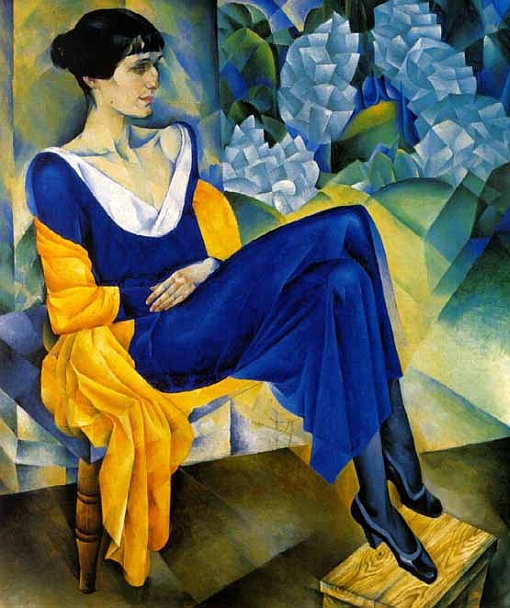
- Image of Anna Akhmatova by Olga Della-Vos-Kardovskaya
- Alla Bayanova sings Anna Akhmatova: “Chernye kosy”
 Anna Andreyevna Gorenko (1889 –1966) is better known by the pen name Anna Akhmatova. She was a Russian modernist poet, one of the most acclaimed writers in the Russian canon.
Akhmatova’s work ranges from short lyric poems to intricately structured cycles, such as Requiem (1935–40), her tragic masterpiece about the Stalinist terror. Her style, characterised by its economy and emotional restraint, was strikingly original and distinctive to her contemporaries. The strong and clear leading female voice struck a new chord in Russian poetry. Her writing can be said to fall into two periods – the early work (1912–25) and her later work (from around 1936 until her death), divided by a decade of reduced literary output. Her work was condemned and censored by Stalinist authorities and she is notable for choosing not to emigrate, and remaining in Russia, acting as witness to the atrocities around her. Her perennial themes include meditations on time and memory, and the difficulties of living and writing in the shadow of Stalinism. (Wiki)
-
Mo Mháistir Dorcha.
Táimse in aimsir ag an mbás
eadrainn tá coinníollacha tairrice
réitíomair le chéile ar feadh tréimhse is spás
aimsire, achar roinnt bliana is lae mar a cheapas-sa.Bhuaileas leis ag margadh na saoire.
D’iarr sé orm an rabhas hire-áilte.
‘Is maith mar a tharla ; máistir ag lorg cailín
is cailín ag lorg máistir .’Ní rabhas ach in aois a naoi déag
nuair a chuas leis ar dtúis faoi chonradh.
Do shíneas mo laímh leis an bpár
is bhí sé láithreacha ina mharghadh.Do chuir sé a chruacaí in lár
cé nar thug sé brútail ná drochíde orm.
Ba chosúla le greas suirí nó grá
an caidreamh a bhí eadrainn.Is tugam a tháinte dubha chun abhann,
buaibh ud na n-adharca fada.
Luíonn siad sios i móinéir.
Bím á n-aoireacht ar chnoc san imigéin
atá glas agus féarach.Seolaim ar imeall an uisce iad
is gaibheann siad scíth agus suaímhneas.
Treoraím lem shlat is lem bhacall iad
trí ghleannta an uaigneas .from : Poetry, Contemporary Irish poetry Oct-Nov 1995. Ed Chris Agee.
My Dark Master
Translated by Paul Muldoon
I’ve gone and hired myself out, I’ve hired myself out to
Death.
We drew up a contract and set the seal
on it by spitting in our palms. I would go with him to
Lateeve
for a year and a day—at least, that was the deal
–
as I remember it. When I met him at the hiring-fair
he inquired if I’d yet
been taken: ‘What a stroke of luck,’ he declared,
‘when a master who’s set on a maid finds a maid who’s set
–
on a master.’ I was only nineteen years old
at the time the bargain was struck.
I made my mark on a bit of paper and was indentured
on the spot. What a stroke of luck,
–
I declare, what a stroke of luck that I fell
into his clutches. Not, I should emphasize again,
that he meddled with or molested me for, to tell
you the truth, our relationship was always much more akin
–
to walking out, or going steady. I lead his blue-black cows
with their fabulously long horns
to water. They lie down in pastures of clover and fescue
and Lucerne. I follow them over hills faraway and green.
–
I lead them down beside Lough Duff
where they find rest and where they are restored.
I drive them with my rod and my staff
through the valleys of loneliness. Then I might herd
–
them to a mountain-pass, to a summit
where they browse on bog-asphodel and where I, when I
look down, get somewhat dizzy. His realm extends as far as the eye
–
can see and beyond, so much so
a body might be forgiven for thinking the whole
world’s under his sway. Particularly after the sough-sighs
of suffering souls
–
from the darkness. He himself has riches that are untold,
coming down as he is with jewels and gems.
Even John Damer of Shronel, even his piles of gold
would be horse-shit compared to them.
–
I’ve hired myself out to death. And I’m afraid that I’ll not
ever be let go. What I’ll have at the end of the day
I’ve absolutely no idea, either in terms of three hots and a cot
íor if I’ll be allowed to say my say. -
In the Storm of Roses, by Ingeborg Bachmann.
“Wherever we turn in the storm of roses,
the night is lit up by thorns, and the thunder
of leaves, once so quiet within the bushes,
rumbling at our heels.”The Broken Heart by Ingeborg Bachmann
“News o’ grief had overteaken
Dark-eyed Fanny, now vorseaken;
There she zot, wi’ breast a-heaven,
While vrom zide to zide, wi’ grieven,
Vell her head, wi’ tears a-creepen
Down her cheaks, in bitter weepen.
There wer still the ribbon-bow
She tied avore her hour ov woe,
An’ there wer still the hans that tied it
Hangen white,
Or wringen tight,
In ceare that drowned all ceare bezide it.When a man, wi’ heartless slighten,
Mid become a maiden’s blighten,
He mid cearelessly vorseake her,
But must answer to her Meaker;
He mid slight, wi’ selfish blindness,
All her deeds o’ loven-kindness,
God wull waigh ’em wi’ the slighten
That mid be her love’s requiten;
He do look on each deceiver,
He do know
What weight o’ woe
Do break the heart ov ev’ry griever.”
-
Earth Mother
for Firoana.
The plains of Romania
Under thirty degrees of heat
Stretch to the poplar trees
At the edge of the earth.
A weathered peasant lady
Offers me water,
Her toothless smile
Mothers me
As I rest in the shade.
She is a daughter of this soil,
Of sun and sweat and toil.
I am from a city
She will never visit.
As I return her smile
And sip her water
She is every woman’s mother,
I am every woman’s daughter.
from Still, by Helen Soraghan Dwyer.
Máthair Chréafóige
do Firoana
Machairí na Rómáine
I mbrothall an lae
Síneann go poibleoga bhána
Ar imeall an domhain.
Bean chríonna tuaithe
A thairgeann deoch dom,
Miongháire mantach
Dom mhúirniú
Istigh faoin bhfothain.
Iníon chréafóige í,
Iníon allais is gréine.
Ón gcathair nach bhfeicfir choíche
Is ea do thángas.
Aoibh ormsa leis
Ag ól uisce,
Iníon cách mise,
Máthair cách í siúd.
as Faire, le Helen Soraghan Dwyer. Lapwing Publications, Belfast 2010.
Note about the Book.
I picked up this book and another volume of women’s poetry on Saturday, in my local bookshop. The poetry section is well-balanced and stocked. As I have not asked permission to advertise the shop, so I won’t name the wonderful proprietor yet. Suffice it to say that she also does some excellent internet ordering , and has some independently bound essays which are virtually impossible to get in Ireland. I shall edit this with a link to catalogues in the near future.Máthair Chréafóige – Earth Mother by Helen Soraghan Dwyer. From Still – Faire. Trans, Bernadette Nic an tSaoir Lapwing Publications 2010.
-
We, the rescued,
From whose hollow bones death had begun to whittle his flutes,
And on whose sinews he had already stroked his bow—
Our bodies continue to lament
With their mutilated music.
We, the rescued,
The nooses would for our necks still dangle
Before us the blue air—
Hourglasses still fill with our dripping blood.
We, the rescued,
The worms of fear still feed on us.
Our constellation is buried in dust.
We, the rescued,
Beg you:
Show us your sun…. but gradually.
Lead us from star to star, step by step.
Be gentle when you teach us to live again.
Lest the song of a bird,
Or a pail being filled at the well,
Let our badly sealed pain burst forth again
And carry us away—
We beg you:
Do not show us any angry dog, not yet—
It could be, it could be
That we will dissolve into dust—
Dissolve into dust before your eyes.
For what binds our fabric together?
We whose breath vacated us,
Whose soul fled to Him out of that midnight?
Long before our bodies were rescued
Into the arc of the moment.
We, the rescued,
We press your hand
We look into your eye—but all that binds us together now is leave-taking.
The leave-taking in the dust
Binds us together with you.
 Chris Murray