• chris murray
  • journals – bibliography – publication notes
  • downloadable items – essays – media
  • copyright
  • Home

Chris Murray

  • eve labouring for 37 hours, the ‘yes’ poem – gold friend

    September 25th, 2021
    eve labouring for 37 hours; the 'yes' poem
    
    Great
    monumental
    Eve in pain
    
    will bring
    forth a Cain /
                           Abel 
    Cannibal.
    
    Exhausted stretch
    rather/rather/rather
    rather/rather/rather
    dilate/ than die/ yes,
    
    So just. Sous justice.
    En vertu de la justice,
    Pour:
    
    (‘In sorrow you shall bring forth children’)
    
    Face? Yes, yes! Present. Hands?
    Yes. His image, 
    who conjured it?
    
    Mouth of dry twigs
    
    the /sticks / stones
    bones/ buttons
    a knee-piece/ skulls          the threads— 
    
    There are piles of skulls
    pushing through my grimacing cunt,
    
    All the pretty things,
    the stones/ bones /buttons
    A knee-piece/ skulls          the threads — 
    
    Sous justice.
    

    Copyright Chris Murray, 2016, 2020

    Published Leuvre Litteraire #12

    Collected Gold Friend, Turas Press 2020

    Online URL https://turaspress.ie/shop/gold-friend-by-chris-murray/


  • “Limerence” and other poems by Palmer Smith

    November 22nd, 2020

    limerence

    i loved a somnambulist
    we’re like a No(thing), a No(body)
    two no-bodies equal Somebody, right?
    (re)-read my words
    bottle of tequila, all the limes
    all the girls you have loved,
    shaken up in this cup i lovingly stirred

    you stumble on red oak floors ceiling,
    a map of london lon-don-ing you
    illicit, (i)llicit you, i’d like to
    “I need some tea…eaRl gRey”
    i never could roll my “r’s” like you
    Afraid to WAKE you
    an alarm could ring;
    a poptart-realization could occur
    you might realize what’s happening
    when you hear the 11 o’clock news
    (world news tonight, it’s good to have you with us!)
    Present, presently? a gunshot to knee on 4th street

    limerence in honeycombs
    honey-orange sandwiches dissemble my skin
    i let the honey in just like you
    so (fool)ish, like a clown face
    with a red button as a nose
    Dying out, the bees are
    dying out, not you; you might be
    (a)round for (some)(time)
    brown-amber eyes, did you know
    that insects are stuck in amber?
    they cannot escape the stick-i-ness
    of the sweet sap, i might become one of them,
    my wings are too fragile to be touched by
    a nothing like you your fingers,
    prints, imprints, do you love me?


    One Night You Grew Silent

    You said you wanted me
    when you turned to face the lamppost.
    The snowflakes caught your eyelashes
    on the last languid Christmas.

    Your fingertips braided my hair.
    Your chilled lips smoothed my legs.
    Your breath in hot clouds warmed my skin.
    Maybe I love you a little.

    I stand in line at the Drug Store.
    There are fake Christmas trees.
    I stand in line with closed eyes.

    In the warm bathwater
    I inhale the exhaust
    of a cigarette smushed
    into my mother’s glass bowl.
    A reflection of my stomach,
    of what could be below it…

    And then I hear the phone line go numb.
    Lifted the window to devour the snowed
    and bitten air on a wet,
    soon to be whaled body.


    Ladybug

    Upon a mint leaf appeared a beet-red ladybug.
    Her left wing dilapidated, her black eyes tearing,
    She whispered into my ear, “My heart feels a-tug;
    …my love has left me, and thus, I am fearing.”

    I inquired as to what had occurred.
    She turned her gaze towards the dampened ground.
    “Infidelity,” was the only word.
    She fluttered a wing, without a sound.

    “What is heartbreak?” we asked one another.
    The male species is so damn unsatisfied.
    Heartbreak is when a heart no longer flutters;
    It is faced with a stomping reality: he lied.


    Body #19

    They called me body #19
    when I laid under the half-door
    of this half-block,
    depleted of what existed above.

    Nineteen, an odd, uneven,
    unsure number. I observe
    a deleted city, uneven in its skyline,
    like a mouth without its biggest teeth
    to help swallow its food.
    It coughs and begs for someone
    to help it, with a flailing tongue.
    It is one of many mouths.

    A number identified me…
    not my hair, or my skin colour.
    I would be counted amongst 20.
    This I did not know until weeks later,
    when wild newscasters counted
    the remaining bodies like stars
    on their fingers.

    To count 20 stars
    in a Manhattan sky would be rare.
    But bodies? What was rarer?

    A waking moment: atop smoky glass
    and blood burned atop wooden desks,
    with loose elevator buttons,
    I counted the people surrounding
    the rubble. They amassed to more stars
    than I would ever count,
    even on a clear night.

    © Palmer Smith 2020


    Palmer Smith is an emerging writer who began her MFA in September 2020 at Columbia University. She is a graduate of Sarah Lawrence College and wrote for the SLC Phoenix newspaper while in college. Her article, 23 Life Lessons was published in Thought Catalog, becoming an Editor’s Pick of the Week in June 2018. She writes about American Southern culture, relationships, childhood, and dreams. She hopes to teach writing and literature at the college level.

  • Protected: ‘Early risers’ by C. Murray

    This content is password-protected. To view it, please enter the password below.

  • “Moss” and other poems by Niamh Twomey

    November 1st, 2020

    Homing Salmon

    Under the gush of shower water your greying skin
    flails. In your mind you wade back to the brook,
    the water icy even in summer, your seven siblings
    balancing on the pebbled belly of the River Fergus,
    suds in your hair, brothers dunking you under, ice forming
    in your brain, penetrating your veins, Mother shouting Don’t
    catch colds. No one but the river ever taught you how to swim.
    Sometimes a silver fish would scurry by upriver. Everyone would freeze,
    crane for a glance before it flickered past. Salmon, Father said.
    Your brothers always poked the verge with sticks, boasted they could catch it.
    Their brittle frames have since sailed over the shoulders of their sons
    to the graveyard by the river but you remember them young.
    Under the gush of shower water your greying scales
    glisten in autumn sun.

    (First published in Crannóg 53)


    The Wooden Ladder

    My Grandfather was a carpenter.
    Sometimes he made toys for me
    with odds and ends from the firebox.
    Once, he made me a ladder for my dolls;
    it had three rungs, rigid and rounded.
    I imagined it was cut from a fancy staircase.

    Its two stringers, the length of my arm—
    the length of his hand, were parallel. I checked.
    I learnt that word,
    it means they’re standing right beside each other
    but even if they go on forever in a straight line,
    they will never touch.

    My doll’s feet didn’t need to touch the rungs
    for them to leap up the ladder;
    propped against a shoebox in my playroom.
    They were steady in my hands
    like the saw in his when he drove
    his mark into the wood.

    (First published in the Qutub Minar Review Vol. 2)


    Moss

    for Ellen Hutchins (1785—1815)
    “send me a moss, anything just to look at” –from Ellen’s last letter before she died

    Here; a grey-cushioned Grimmia.
    Here, a flaccid Brachythecium spine.
    Thyme-moss, Hart’s-tongue, Sphagnum.
    And let me take you under the sea;
    a hive of sweet kelp, bouquet of carrageen
    bedded in a throw of Dulce.
    Knotted in sea spaghetti away from your fossilising name.
    I hope you died looking at your moss,
    stalks of haircap painting a different set of stars.

    (First published in Boyne Berries 27)


    When I Visit You Now
    
    There’s a code for the door.
    No smell of rollies,
    no garden to capture
    with a disposable camera.
    
    But your brail-veined arms
    stretch out to me in welcome.
    
    	You’re a salmon, I think,
    head bowed under the weight of scales
    and I a poet trawling
    natal streams upriver, digging
    tiers along the riverbank 
    as we walk to the dayroom
    
              then back
    
        but you slip 
    
    from my grasp,
    sinking to the riverbed–
    staring at the television.  
    
    
    (First published in the Qutub Minar Review Vol. 2)

    Niamh Twomey is a writer from County Clare. Her poetry has appeared in various journals and anthologies including Boyne Berries, Crannóg, and the Ireland Chair of Poetry Commemorative Anthology. She holds a BA in English and French and an MA in Creative Writing, both from University College Cork.

  • “I don’t belong here’ by Fizza Abbas

    October 18th, 2020

    I don’t belong here

    I love chipped crayons,
    they tell me colours can come in different forms:
    pitch-black darkness can become the reincarnation of red,
    moonlight can subdue the proud ribbon-like body of the river,
    wise men need not have a white beard.

    I often whisper to the wavelength,
    ask her to, once, and for all,
    be flexible if dispersion is an absolute necessity,
    to tune into madness
    even if it’s her least-favourite frequency.
    Sometimes, I even read her poems,
    so she knows I have word bubbles
    that don’t blow my way.
    Similar to the paintballs
    that she complains are too unruly and wild.

    I am a laywoman,
    with no command on phonetics
    the shit sounds similar to me,
    I often tell my husband–
    take care of calories, the shit,
    he, being the ultimate Science guy,
    says, it’s a good fat joke

    Once in a while, we’re on the same wavelength.

    Nibbling the crayons, I often think,
    I too can think.


    An old woman judges me in a gathering

    I find the silhouette of mom against the stunning sunset, tracing my footprints when a 70-year-old woman flaunts her half-tamed cupid’s bow in a majlis.

    She looks for a golden ratio; here lies square, oval, rectangle congruent with the door, bar and a crosspiece.

    Fizza Abbas is a freelance content writer based in Karachi, Pakistan. She is fond of poetry and music. Her works have been published on many platforms including in Poetry Village and The Cabinet of Heed.
  • “Passing through” and other poems by Betty Thompson

    October 18th, 2020

    Balloons

    A stream of them – long and
    ribboning before they were inflated;
    breath-filled they turned into
    globes and cylinders: fat demi-lunes
    ably shaped by the long-fingered
    magician who, in his downtime
    offstage from the Hippodrome,
    relaxing by the fire, legs stretched
    across the hearth, would plunge
    those long hands into his pockets,
    to pull out rubber neon
    proto-chameleons. How he joined
    limbs and torso, how he conjured
    heads, ears and tails, I never knew,
    just watched this flow of colour
    and shape become a rabbit or a cat.
    My own cat retreated to the yard
    when this post-performance
    played out: a narrow space, walled
    high with London bricks, it shielded
    her but not me from the fear I felt
    when he threw his voice out there
    to ricochet into the kitchen,
    a prelude to his suite of tricks.
    There were cards among his props
    that he showed and shuffled, got
    some gasps in return, but not from
    me. As for the bouncy animal he
    gave me – a red rabbit with swelling
    ears – I pressed till I found a bursting
    point. This was after I had seen,
    through the back window of his
    parked-up van, a cage of doves.


    Passing Through

    Do you find it dark in the underpass?
    Crab of the thorn, a small light for small people.
    The travel time is short. I’ve counted the steps
    From start to finish. What’s more, St. Lucy
    Blesses passers-through, steadies their heartbeat.
    Her icon is set into the curvature of the archway.
    Look up at the gold leaf glinting. Then emerge
    To see the vista of a city farm, its luminous glass
    Porch, eau-de-nil paling, fronds of faded lavender
    On the verge. If you are there, the street is not
    Abandoned. On sad days, I try to remember
    The name of Johnson’s cat, memorialized in bronze
    In a London square. It comes eventually, bringing solace.

    Note: Line 2 is from ‘The Haw Lantern’ by Seamus Heaney.


    Quay

    In those minutes close to twilight
    when the air shines
    and the sky is pale as layered muslin,

    trees swayed in a line along the quay.

    In the river’s waves –
    vivid as ink wedges on a Japanese scroll –

    in the curving, widening river,
    and on the road above, a bus appeared.

    Its ample shape grew.


    Gérard Depardieu in Eustace Street
    
    His fleshy face aslant fills the screen
    here in this vaulted room
               still light enough to see the patina on oak
    
    though the lights are down
    as I sit in a plush row where
    benches used to seat the friends who met here
    
    in silence mostly
    unless one felt impelled to speak
     about the light within.
    
    We too sit in silence
    looking up at the screen of light
    receiving its forms and tints, tracking their force,
    
    tasting the full        mouthed vowels and moist consonants
    of its habitués this day
            who, sojourning in the drab part of town,
    
    relocate for a scene or two
            to its volcanic hinterland
    to daze themselves with light and air.
    
    Gérard Depardieu in Eustace Street and other poems © Betty Thompson

    Betty Thompson was born in Dublin, now living in Enniscorthy, Co. Wexford. Graduate of UCD, the University of Bristol, and Bath Spa University. A collection entitled Painting the Vestibule published in 2009 by Scallta Media. Poems have appeared in Coffee House Poetry, Crannóg, Cyphers, The SHOp, Poetry Ireland Review, The Scaldy Detail, and The Irish Times, and included in the anthology If Ever You Go: A Map of Dublin in Poetry & Song, edited by Pat Boran and Gerard Smyth (Dedalus Press, 2014). They can also be found on the Irish Film Institute website, on the Coffee House Poetry website, and on the website of the UCD Library Digital Irish Poetry Reading Collection. I am a member of the Irish Writers Centre and I took part in the Women Across Borders Literary Readathon there in 2018.

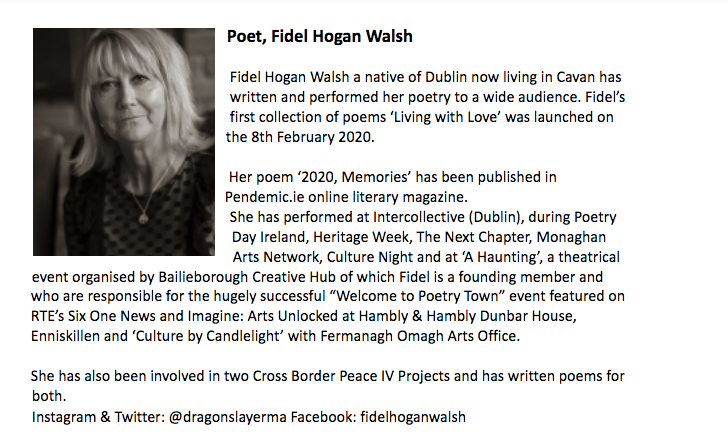
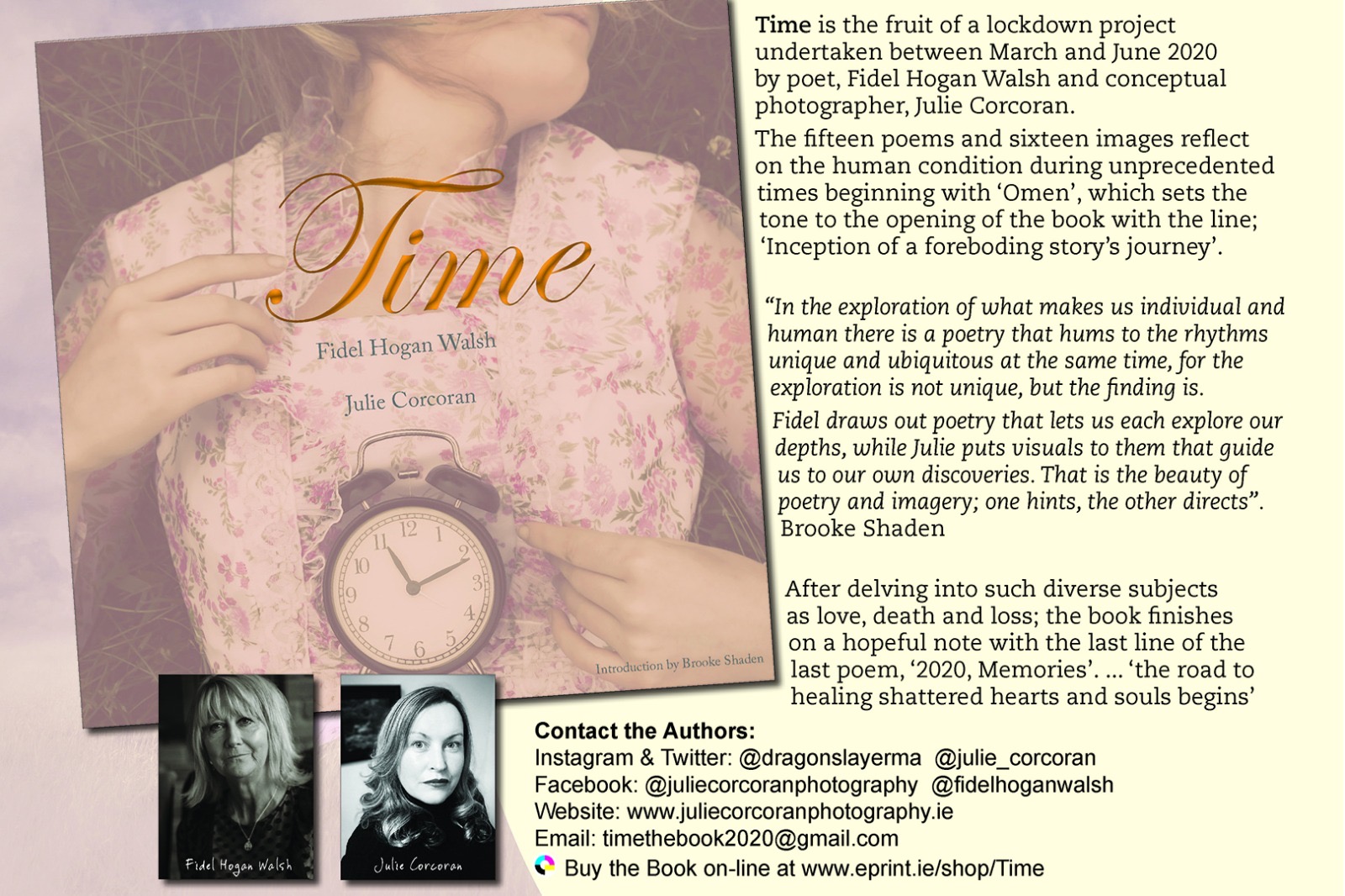
  • “Time” by Fidel Hogan Walsh and Julie Corcoran

    October 10th, 2020

    2020, Memories

    Blinded in a winter’s dread no prophet foresaw.
    Spring’s new life erupted into a chaos of fear.
    Desolation replaced the warmth of a hug.
    Children banished from our everyday lives!

    Ahh, the blessings — a swift journey home
    to the unexpected happiness under one roof.
    Chatter, laughter —
    a family enduring dark days
    come what may….

    Time, the pickpocket of memories stood still.
    Watching, new ways of keeping our spirits alive,
    to be remembered, cherished.
    Lost moments recaptured before Summer’s end….

    An invisible killer started a war,
    so much pressure on our frontline.
    But it would be,
    ‘Love and Stay at Home’
    that had their backs.

    Death came at a fast pace.
    Isolation, the enemy of a treasured last goodbye —
    grief mourned in silent lockdown.

    And now,
                                       the road to healing shattered hearts and souls begins!


     Family Love
     
    Father. Mother.
                Daughters. Sons.
                                Grandchildren. 
     
    Love weaves its magical thread
             intricately throughout the ages.
    Forging unbreakable bonds.
     
                    Out from nowhere,
    an unnatural enemy wreaked havoc
               on the close-knit unit.
    They endured great sadness and turmoil.
              Separation with no hugs
    to warm the blood, tested their strength… 
     
    Generations fought for survival
    alongside the mightiest warrior of all — Love.
     
    And the family stood firm.
    A force to be reckoned with!


    Omen

    Common sense flees at the first sign of fear,
    hostage to an ever sense of madness.

    Inception of a foreboding story’s journey!
    I see; the one eyed child dancing on her grave — the ruins of mankind.
    I hear; the dark one singing an ancient curse — a prayer not heard.
    I smell; the rotting of bodies — soul thieves wanton destruction.
    I touch; the soiling of a pure heart — unholy spirits grasp hold.
    I taste; the drowning miseries in the afterlife — ripen death.

    Saving the dead or killing the living?
    On a night when the full moon is covered by cloud!

    Words © Fidel Hogan Walsh / Images @ Julie Corcoran


  • Poems from ‘My Name Is’ by Polina Cosgrave

    October 5th, 2020

    Starship

    The blackest of holes,
    the hottest of suns,
    the craziest captain alive.
    Surrender to none,
    be gentle to some,
    stay tough as the skies collide.
    The milkiest way is over my head.
    They’re chasing me mile after mile.
    This starship is mine,
    try and catch me, I said.
    This marvellous starship is mine.


    Self-portrait

    I’m almost young and comparably civil
    for someone who nurtures her inner cynic,
    I have a soft spot for Charles Simic,
    Nintendo and soda bread.

    I’m somewhat Russian and kind of solid
    for someone who never knows when to call it,
    I once loved a redhead, I wrote her sonnets,
    but now the romance is dead.

    She wished I had stayed in the capital city,
    took care of her kitty, who’s bald and unpretty,
    She said I was deadly at cooking and twitting.
    my words and my soup turned sour.

    I wished she had moved with me to the Ocean,
    but she couldn’t swim, and I hadn’t a notion.
    We blew our life jackets out of proportion
    and labelled each other as cowards.

    It’s crazy how even the Arctic winter
    seems warmer than feelings which soon will wither.
    I could live without her, but hardly with her.
    It’s not the winning that counts.

    I’m lucky the sun in my garden is blazing,
    I’m planting my saplings and I will raise them
    with leaves full of poison and sharp as razors,
    with crowns that shall pierce the clouds.


    Dog I Can’t Keep

    First language is a dog I can’t keep anymore
    barking in the back of my mind.
    Stay, I command.
    But it goes wherever it pleases,
    reminding me who is the real owner here.
    Its growling is so powerful that all other sounds get lost in it.
    Your bites leave no scars anymore, I say.
    I’ll find you a new home, I say.
    It grins.
    First find yourself one.
    Its jaws are closing around my neck.


    Tattoo

    Homeland
    is tattooed on my skin,
    and the picture is changing in real time.
    Here is my school friend’s fresh grave,
    here is yesterday’s theatre student
    in a prison transport vehicle,
    here are the ashes of Siberian forests,
    here are the history books being rewritten.
    And here is the apple tree in my parents’ garden
    blossoming, just like any other year,
    and it’s my favorite part of the tattoo.
    One day I’ll have the rest of it removed.

    Poems from My Name Is © Polina Cosgrave

    Purchase link for Polina’s book.


    Polina Cosgrave is a Russian-born poet based in Ireland, published in a number of journals and anthologies, including Writing Home by Dedalus Press. Her work was featured on Echo of Moscow radio station, Russia-K channel, RTÉ Radio 1, The Irish Times, Arts in Action NUI Galway and Mother Tongues Festival. Polina’s debut poetry collection My Name Is is published by Dedalus Press.

  • ‘Imprint’ by C. Murray

    September 29th, 2020


              Amber
      her halls—
    by the periphery trees
    open out sky's lungs.
       There are small birds
    below, 
          they sing
            her boundaries: 
     clay and Blue–
    this living thing.
    I touch her skin, it
    strikes White   heart
    -wood      blood runs 
        white with light.
    She tells her tale,
    Silver  
           beech,
    a wren–
                       
               © C. Murray 2020
    
    Read A Hierarchy of Halls 


    Imprint by C. Murray is licensed under a Creative Commons Attribution-NonCommercial-NoDerivatives 4.0 International License.

  • Poems from ‘Alchemy’ by Fiona Perry

    September 26th, 2020

    Postpartum

    You are as naked as a shucked oyster
    so, my breasts are slashed and raining pearls
    for you, my suckling child. The universe
    has too many doors. A terrifying flower
    unfurled overnight to tell me if they took
    you away or carted you off to die
    like pink tender veal. I would be prepared
    to stand on my own mother’s shoulders
    to push you back up to the surface, to stop
    you from drowning— and she would want that—
    because she too must have discovered this feral
    wisdom in the bloodied wake of birth. Everything
    is unfastening around me, voluptuously, in ways
    I cannot understand yet. For now, I must be patient
    occupy this hinterland and allow the stars to realign.


    The Jesus Woman

    After James K Baxter

    I saw the Jesus Woman
    milling around the school gates.
    She wore grey marl track pants,
    her hair was scooped up into a pineapple bun.
    her breath smelt of coffee and ginger biscuits.
    When babies cried, her breasts leaked milk.
    When she smiled, birds flitted like glitter
    among the trees. When she screamed
    tectonic plates shifted. When she laughed
    everybody got high.

    The Jesus Woman sat in a café
    and selected her twelve disciples.

    One was a schoolgirl panicking in an airport toilet
    soon to be married in an unfamiliar country.
    One was a waitress who dropped her stillborn child
    into a storm drain on Good Friday and ran away.
    One was a grandmother who couldn’t read or write.

    One was a freshly-battered office manager whose
    husband supported a football team that had just lost 99-0;
    One was a self-harming solicitor who advised
    clients in an office festooned with original artwork.
    There were seven others. But their identities have been
    suppressed to protect the powerful.

    The Jesus Woman said, ‘Ladies, from now on,
    the rain will wash away our worries’.
    She did no miracles.
    She sometimes sold old clothes on eBay.

    The first day she was arrested
    for having a backstreet abortion.
    The second day she was beaten by villagers
    for accusing a pillar of the community of rape.
    The third day she was charged with being a woman
    and given twenty five years in a Magdalen laundry.
    The fourth day she was sent to an asylum
    for admitting she wasn’t cut out to be a mother.
    The fifth day lasted for four years
    while she worked as a comfort woman
    constantly within the grasp of soldiers.
    The sixth day she told her abusive father,

    “I am the light of the world.
    I am the one who brings into being.”

    The seventh day she was set on fire:

    the flesh of God was burnt to ash.

    On the eighth day the earth stopped turning.
    All of creation began to cry.

    Every night these tears are collected
    into a bottle for reckoning at the end of days.


    Intensive Care

    it does me no good to pay
    attention to the shushing

    sound of the ventilator or
    the incessant twinkle of

    machine lights, let me
    pretend to follow

    you (like a scuba diver)
    gliding through lough waters

    the passing of the Bann
    Foot Ferry above us

    chugging its cargo of suited
    and booted brylcreemed boys

    girls with shiny evening bags
    resting on swing-skirted laps

    our bodies are clouds now
    we are wearing crowns

    of marsh thistle we
    want to stay just here

    but currents are carrying
    us away in their eddies

    you reach the shore
    and stretch out on your back

    inviting me to place my head
    on your belly, the weight

    of it makes you smile because
    this is how it once was

    me curled up like a nautilus
    sleeping in your womb

    Poems from Alchemy © Fiona Perry


    Preorder Alchemy at Turas Press https://turaspress.ie/shop/contemporary-poetry-alchemy-by-fiona-perry-debut-collection-from-turas-press/


    Fiona Perry is the author of Alchemy from Turas Press (October 2020), a book termed as ‘an intriguing and compelling début collection from a poet who is already strikingly in command of her craft. Mingling daily life with the numinous, these poems reflect on love and loss, on the milestones of lived experience. These poems travel through time and space: from the magic of ancient birds in a New Zealand landscape, to the intensive care ward where a loved one lies dying; from the daily round of household tasks, to the dreamworlds where memory, imagination and reality merge’. Fiona has won the Bath Flash Fiction prize for her story, Sea Change. Her work has been published widely in Ireland, the UK, Australia, New Zealand, and India. Recent work has appeared in Lighthouse, Not Very Quiet, and The Blue Nib. She contributed poetry to the 2019 Label Lit Project for National Poetry Day, Ireland.
←Previous Page
1 2 3 4 5 6 … 106
Next Page→
 

Loading Comments...
 

    • Subscribe Subscribed
      • Chris Murray
      • Already have a WordPress.com account? Log in now.
      • Chris Murray
      • Subscribe Subscribed
      • Sign up
      • Log in
      • Report this content
      • View site in Reader
      • Manage subscriptions
      • Collapse this bar