This poem, by Duffy is taken from the 1996 Poetry Ireland Review (PIR) issue 49. Ed, Liam Ó Muirthile.
Map.
Islands, lovingly described, unfold.
Each day, from its catalogue of wonders, we choose the cockle strand, the puffing holes, the temple of the four beautiful saints
and wander the ceathrúnas’ ancient longitude and latitude of sea-weed rights ; piecemeal intimations of a people’s pressing wish to green the stone world.
We follow the coast – line’s chequered fortune avidly, eventful geology rendered decorative as medieval pageantry. Crosshatched cliffs joust with a stippled sea.
The man we rent our caravan from knows the map-maker – an englishman who speaks Irish – nach bhfuil sé sin i gcoinnne an nádúir ? he asks, only half-joking. Anxious for dragons, we slither to Poll na bPéist. The map rustles, governs our journeys gently .
Every verse is a child of love, A destitute bastard slip, A firstling – the winds above – Left by the road asleep. Heart has a gulf, and a bridge, Heart has a bless, and a grief. Who is his father? A liege? Maybe a liege, or a thief. by Marina Tsvetaeva
I Know the Truth I know the truth – forget all other truths! No need for anyone on earth to struggle. Look – it is evening, look, it is nearly night: what will you say, poets, lovers, generals? The wind is level now, the earth is wet with dew, the storm of stars in the sky will turn to quiet. And soon all of us will sleep beneath the earth, we who never let each other sleep above it.
“I know the truth” Tsvetaeva (1915). Translation by Elaine Feinstein.
The above link is to Tsvetaeva’s Wikipediapage. This week news reports and statements suggest that Anna Politkovskaya‘s killer is now behind bars. Whilst researching and reminding myself of the small things that I did at the time of her death in 2006, like reading and connecting with the IWMF and publishing about violence against women writers and journalists, I came across some articles about poems, music and protests from those people effected by Politkovskaya’s writing. Interestingly Tsvetaeva’s work was read at the public protests and organically wound into musical tributes. I thought to publish two poems here as a type of memorial to two Russian women writers today.
This post is related to yesterday’s introduction to Jacket 2, which is linked here. Jacket2 and writers like Afilreis use social-media and Twitter to disseminate serious poetics. I started to write about Hannah Weiner as an addendum to a wider article on Jacket 2 last week, but thought that I would do some more reading before concentrating on her work alone.
I really (really) like theBook of Revelations by Hannah Weiner , further to that I admire how J2 have presented the piece. The book was composed in 1989 and has been amassed into a virtual edition on the J2 site , by Marta L. Werner. There are seven hyperlinks running alongside the introduction to the text, which I link here.
“save all the surprises for you tonight we can expect anarchy in one moment I will tell you forty nine people cannot stand the beginning was a little bore expect little help from midgets in some sense all words travel there must be no suspicion dont ally yourself with imps”
Hannah Weiner , The Book Of Revelations
To create section 1 (from “forthcoming and absolutely” to “no one can eliminate a particle”), Rosenthal placed a steel straight edge on the page in sequenced parallels and grasped at the paper in the lower corner with her right hand, bearing down on the steel with her left and pulling upward to form straight rips with a slightly textured edge; to create section 2 (from “read more about it in the papers” to “absence of time between 5 and 7”), she used an X-Acto #2 fine point blade to slice concentric or nested angles or rectangles.”
I also thought, being in a generous type of sunlit-mood (at time of writing) to add a piece of the audio archive from PennSound !
Everyone has their own tastes in poetry, and this blog is intended mostly to expand out the experience of poetry through linking and integrating online resources.
“Looked after only by the four womb-walls, if anything curved in the ruined city his last hour it was his human hands, bituminous, while all laws were aimed at him, returning to the metre of a star: like a century about to be over, a river trying to film itself, detaching its voice from itself, he qualified the air of his own dying, his brain in folds like the semi-open rose of grief. His eyes recorded calm and keen this exercise, deep-seated, promising-avenues, they keep their …kingdom: it is I who am only just left in flight, exiled into an outline of time, I court his speech, not him. This great estrangement has the destination of a …rhyme. The trees of his heart breathe regular, in my dream. “
from, The Making of a Sonnet, a Norton Anthology. Eds ,Edward Hirsch and Eavan Boland. Published 2008.
Simone Weil was an outsider, this she clearly stated in her personal letters and essays which are gathered in fragments or in small volumes, such as in Waiting for God. Those meagre fragments that have been published are not really readily accessible save on the curriculums of theological colleges (in modular forms) and presented in a contextualised and safe manner. I do not think that her writings on mysticism have been done justice in contemporary thought.
Weil’s themes are of her intellectual alienation from Catholicism (and her desire of it), poverty, philosophy, war, struggle, and totalitarianism ,
“A collective body is the guardian of dogma and dogma is the object of contemplation for love, faith and intelligence, three strictly individual faculties. Hence almost since the beginning the individual has been ill at ease in Christianity and this uneasiness has notably been one of intelligence, this cannot be denied” (I: 314)
and yet, in further essays on education, philosophy and the need for frontline nurses, Weil rejects civil law as aberrant and only necessary to prevent religious totalitarianism. Her dividedness is a mark of her deep and enduring thought on education and its uses, which can be reduced to the cultivation of attention. Here, Weil’s thoughts could be placed alongside other catholic women thinkers but her refusal of baptism puts paid to that. Her ideas culminate in the magnificent and difficult poetic work, Necessity.
I question why the work of Weil is not put on a par with her contemporary Paschal, or any comparative writer of religious mysticism. I can only imagine that her desire to be an outsider has been readily and promptly answered by those guardians of her letters (thoughts) in their failure to categorise her sufficiently in the annals of the catholic thinking which she so desired and yet so readily and completely rejected,
“Nearly all our troubles come to us from not having known how to stay in our room,” said another sage, Paschal, I think, thereby calling to mind in the cell of recollection all those crazed people who seek happiness in movement and in a prostitution I might call fraternal, if I wanted to use the fine language of my century. ” ( I:314)
I suppose it is difficult if one approaches the writings of a female mystic and powerful writer to safely categorise and apply a workable label to her when her outsider status was so firmly delineated by writing that does not really achieve for the reader a comfort-zone that can be safely and inalienably tagged as pedestrian. She presents a difficulty for those guardians of dogma who would rather not approach the questions of the post war-time era in a manner that may jolt sensitivities in those areas of agnosticism, anarchism, and mysticism discussed by Weil in her letters. There are many such neglects in contemporary thought on issues of philosophy and religion, though mostly they (or their invisibilites) apply alone to women writers of depth and clarity, such as the great Simone Weil. I am excerpting Le Personne Et La Sacré by Simone Weil, in which she develops her ideas regarding the individual cultivation of attention as the most necessary of those approaches to study and whilst I may not agree with her ideas on dogma and justice, I find her constant and integral struggle with the problems of developing the intellect to be almost pressing when so much of post-modernism is directed toward the degradation of the intelligence in favour of willful and negligent consumption,
Le Personne et la Sacré : by Simone Weil
“Beauty is the supreme mystery in this world. It is a brilliance that attracts attention but gives it no motive to stay. Beauty is always promising and never gives anything; it creates a hunger but has in it no food for the part of the soul that tries here below to be satisfied; it has food only for the part of the soul that contemplates. It creates desire, and it makes it clearly felt that there is nothing in it [beauty] to be desired, because one insists above all that nothing about it change. If one does not seek out measures by which to escape from the delicious torment inflicted by it, desire is little by little transformed into love and a seed of the faculty of disinterested and pure attention is created.”
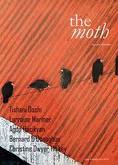
The moth, arts and literature magazine is linked at the end of this short introductory. I picked up my copy at the newsagent at Easons in Heuston station. It proved a very popular read on holiday and I barely got my hands on it. I wondered whether I should just link a poem or mention the art, but like all good magazines, it is how the whole is edited, rather than the plucking from it of tidbits or tasters that makes it work as a publication.
Poems are by Daragh Breen, Paul Keenan, Mairéad Donnellan ,Tishani Doshi , Evan Costigan, Bernard O Donoghue, Helena Nolan, Lorraine Mariner, Peter Fallon and Jessica Traynor.More poems are by Rebecca O Connor, Richard W. Halperin , Andrew Elliot and Niamh Boyce. The magazine is replete with limpid images by Ralph Kiggell, Bill Griffin, Nathalie Lete and Theresa Ruschan. Short fiction, Interviews, and a Shane Connaughton play also form the body of the magazine.
Ember
by Rebecca O Connor.
The sky is the white smoke of a quenched fire, and his heart is loose, poor George. Peppa says he must stay in bed for three years, which is what passes for a weekend here.
My heart too is loose, needs its noose tightened. And just as I say this the sun seeps wetly through to remind me that something smoulders, something still burns.
by Rebecca O Connor
The Moth, cover illustration ‘The Red Shed’, by Vincent Sheridan
It breaks apart as water will not do when I pull , hard, away from me, the corners bunched in my two hands to steer a true and regulated course.
I plunge the needle through and through, dipping, tacking, coming up again. The ripple of thread that follows pins, out of its depth , a shallow hem.
I smooth the waves and calm the folds. Then, to ensure an even flow, I cast a line which runs from hook to hook and pulls the net in overlapping pleats.
Which brings me to the point where I am hanging a lake, by one shore, in my room, to swell and billow between the light and opaque , unruffled dark.
I step in. The room closes round me and scarcely puckers when I move my limbs. I step out. The path is darkened where I walk, my shadow steaming off in all this sun. from : The New Irish Poets , Edited by Selina Guinness . Bloodaxe Books 2004
Táimse in aimsir ag an mbás eadrainn tá coinníollacha tairrice réitíomair le chéile ar feadh tréimhse is spás aimsire, achar roinnt bliana is lae mar a cheapas-sa.
Bhuaileas leis ag margadh na saoire. D’iarr sé orm an rabhas hire-áilte. ‘Is maith mar a tharla ; máistir ag lorg cailín is cailín ag lorg máistir .’
Ní rabhas ach in aois a naoi déag nuair a chuas leis ar dtúis faoi chonradh. Do shíneas mo laímh leis an bpár is bhí sé láithreacha ina mharghadh.
Do chuir sé a chruacaí in lár cé nar thug sé brútail ná drochíde orm. Ba chosúla le greas suirí nó grá an caidreamh a bhí eadrainn.
Is tugam a tháinte dubha chun abhann, buaibh ud na n-adharca fada. Luíonn siad sios i móinéir. Bím á n-aoireacht ar chnoc san imigéin atá glas agus féarach.
Seolaim ar imeall an uisce iad is gaibheann siad scíth agus suaímhneas. Treoraím lem shlat is lem bhacall iad trí ghleannta an uaigneas .
from : Poetry, Contemporary Irish poetry Oct-Nov 1995. Ed Chris Agee.
My Dark Master
Translated by Paul Muldoon
I’ve gone and hired myself out, I’ve hired myself out to Death. We drew up a contract and set the seal on it by spitting in our palms. I would go with him to Lateeve for a year and a day—at least, that was the deal – as I remember it. When I met him at the hiring-fair he inquired if I’d yet been taken: ‘What a stroke of luck,’ he declared, ‘when a master who’s set on a maid finds a maid who’s set – on a master.’ I was only nineteen years old at the time the bargain was struck. I made my mark on a bit of paper and was indentured on the spot. What a stroke of luck, – I declare, what a stroke of luck that I fell into his clutches. Not, I should emphasize again, that he meddled with or molested me for, to tell you the truth, our relationship was always much more akin – to walking out, or going steady. I lead his blue-black cows with their fabulously long horns to water. They lie down in pastures of clover and fescue and Lucerne. I follow them over hills faraway and green. – I lead them down beside Lough Duff where they find rest and where they are restored. I drive them with my rod and my staff through the valleys of loneliness. Then I might herd – them to a mountain-pass, to a summit where they browse on bog-asphodel and where I, when I look down, get somewhat dizzy. His realm extends as far as the eye – can see and beyond, so much so a body might be forgiven for thinking the whole world’s under his sway. Particularly after the sough-sighs of suffering souls – from the darkness. He himself has riches that are untold, coming down as he is with jewels and gems. Even John Damer of Shronel, even his piles of gold would be horse-shit compared to them. – I’ve hired myself out to death. And I’m afraid that I’ll not ever be let go. What I’ll have at the end of the day I’ve absolutely no idea, either in terms of three hots and a cot íor if I’ll be allowed to say my say.
Dark angel who art clear and straight As canon shining in the air, Your blackness doth invade my mind And thunderous as the armored wind That rained on Europe is your hair;
And so I love you till I die— (Unfaithful I, the canon’s mate): Forgive my love of such brief span, But fickle is the flesh of man, and death’s cold puts the passion out.
I’ll woo you with a serenade— The wolfish howls the starving made; And lies shall be your canopy To shield you from the freezing sky. Yet when I clasp you in my arms— Who are my sleep, the zero hour That clothes, instead of flesh, my heart,— You in my heaven have no part, For you, my mirage broken in flower, Can never see what dead men know! Then die with me and be my love: The grave shall be your shady grove And in your pleasaunce rivers flow (To ripen this new paradise) From a more universal flood Than Noah knew: But yours is blood. Yet still you will imperfect be That in my heart the death’s chill grows, —A rainbow shining in the night, Born of my tears … your lips, the bright Summer-old folly of the rose.


 Chris Murray